Die With Zero if you don't have kids
Nothing about Die With Zero requires an heir. The book's argument — that money you never spend was time you worked and never converted into anything — applies exactly the same whether or not you have children. What changes without kids isn't the maths. It's that one whole category of decision, when and how much to give them, simply doesn't come up, and a couple of assumptions other guides make by default are worth checking rather than inheriting unquestioned.
What doesn't change
Die With Zero still means finding your die-with-zero number — the largest flat amount you can add to your yearly spending and still land at roughly zero by your planning horizon, with a safety floor kept back — and still means front-loading the experiences your health can carry now rather than deferring them to a retirement that may arrive with a worse body. None of that depends on heirs. If you already ran the number, it's still the number, whether or not you have children.
The one decision that disappears
With kids, the book adds a specific extra step: deciding when to give them money, ideally in the 26–35 window it argues does the most good. That decision, and the modelling that goes with it, simply isn't part of a childless plan. Practically, that means your solved number is already the "no gift" number — you're not carrying a phantom deduction for a gift you were never going to make. It isn't a special no-kids bonus; it's just one line item that a parent's version of the same plan has and yours doesn't.
The assumption worth checking: does the house have to survive you?
Here's a real lever, and it's mechanical rather than philosophical. zeroleft's model treats a home as an asset that grows in value but isn't drawn down for spending, by default — the same way a parent planning to leave the house to their kids would want it treated. Nothing in the engine assumes you have heirs; it simply leaves illiquid assets alone unless you tell it otherwise. If there's no one you're keeping the house intact for, that assumption may not fit you, and the model lets you change it: mark the home as spendable — sell it eventually, downsize, or borrow against it late in the plan — the same as any other asset.
Run zeroleft's own sample plan (a 35-year-old, £380,000 liquid, a £250,000 home, £60,000 of yearly costs) both ways:
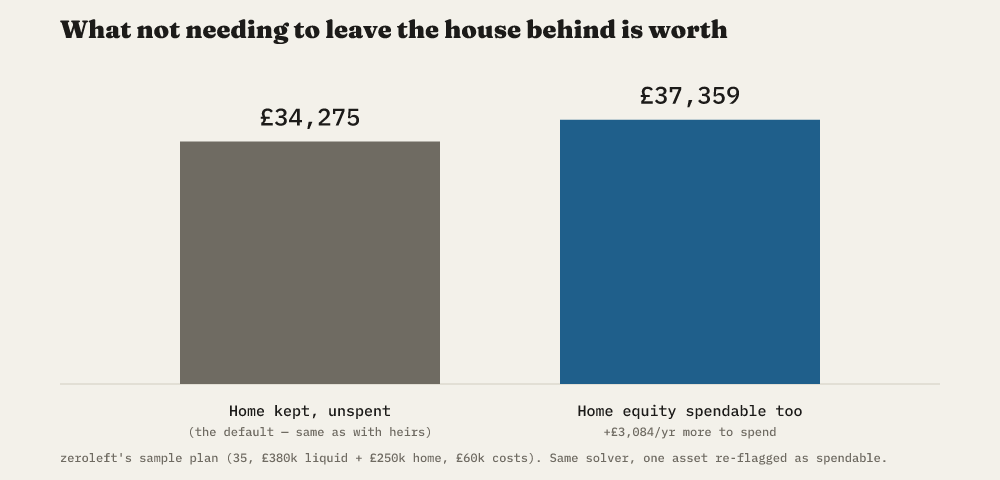
Letting the model spend the home down too moves the solved number from £34,275 to £37,359 a year — about 9% more. That's not a book claim or a research finding; it's zeroleft's own solver, re-run with one asset's liquidity flag flipped. The size of the effect depends entirely on how much of your own net worth sits in an asset like this one — for some plans it will be far larger, for others negligible. The point isn't the specific number, it's that "no one to leave the house to" is a real, checkable input, not just a feeling.
Don't assume you have no bequest motive just because you have no kids
It's tempting to treat "childless" and "no reason to preserve principal" as the same thing. They aren't quite. In a widely cited study of bequest behaviour, economists Wojciech Kopczuk and Joseph Lupton found that 63% of childless households still showed evidence of a deliberate bequest motive, against 79% of households with children — fewer, but a clear majority either way (Kopczuk & Lupton, NBER Working Paper 11767). Wanting to leave something behind — to a partner, siblings, godchildren, or a cause — doesn't require children of your own. If that's you, the honest version of this guide is: your plan can still solve for a target bequest, the same way a parent's can; you're just choosing the number, not being handed it by default.
The reverse gap shows up in giving patterns while people are alive, too. A 2026 survey by Childfree Trust, fielded among 337 U.S. adults, found that 59% of childfree respondents felt the financial advice they'd received focused on building wealth for an unspecified future rather than helping them use it now (Childfree Trust survey via GlobeNewswire) — a small, self-selected sample, mostly women, but it points the same direction as the industry commentary: financial planning defaults to an accumulate-and-transfer model built around heirs, and childless clients are often left to translate that into their own situation by hand.
Where the freed-up spending actually goes
If your number does come out higher, or you simply don't have a gift line item taking a bite out of it, that spending has to go somewhere deliberate or it just doesn't get spent — the over-saving trap again, from a different angle. The usual destinations:
- More of your own experiences, earlier. The same memory-dividend logic that argues for front-loading trips for a parent applies at least as strongly here — there's no competing claim on the money from a child's future.
- People who aren't your children. Nieces, nephews, godchildren, or close friends can sit inside the same 26–35 "money changes a path" window the book argues for; the mechanics are identical to a parent's gift, just with a different recipient.
- Charity, on a schedule you choose. People without children give a meaningfully larger share of their estate to charitable causes than people with children do, and some do it during their lifetime specifically to see the effect rather than leaving it to be administered after death (Merrill Lynch and Age Wave, "Leaving a Legacy" found this pattern generally; it doesn't isolate childless respondents specifically, so treat the direction, not a precise share, as the takeaway here).
What doesn't get easier without kids
A few things this guide would be dishonest to skip:
- Long-term care planning gets harder, not easier. Adult children are, in practice, the default source of both hands-on help and decision-making authority — someone who can act as power of attorney or healthcare proxy — when a plan holder can't act for themselves. Without that default, AARP's guidance for solo and childfree retirees is blunt about naming that person deliberately, well before it's needed, rather than assuming someone will step in. zeroleft has no model for care costs or decision-making capacity — that planning happens outside this tool, but it belongs on the same checklist as the numbers.
- The survival threshold still applies. A higher solved number from spending down a home is still a number at the edge of feasible, for the same reasons covered in the criticisms of the method — it assumes one average return, not a bad decade early in retirement.
- No tax model. Selling or borrowing against a home, and gifts to non-spouse recipients, can carry materially different tax treatment than a straightforward inheritance would. This is a planning aid, not tax advice — check the rules that apply to you before acting on any figure here.
Run it on your own numbers
The book's argument doesn't check whether you have children, and neither does zeroleft. Build your actual plan, decide for yourself whether an asset like a home is there to be preserved or spent, and see what your real die-with-zero number is — with or without a gift line item, with or without a bequest built in on purpose.
zeroleft is a planning aid, not financial, legal or tax advice, and has no model for care costs or legal capacity. It's an independent tool, not affiliated with or endorsed by Bill Perkins or the publisher.
Common questions
Does Die With Zero require you to have kids?
No. The book's core argument — spend the money while it can still buy you something, rather than dying with an unspent pile — has nothing to do with heirs. Having kids only adds one extra decision: when to give them money. Without kids, that decision doesn't arise, and the plan is otherwise the same.
Do childless people get a higher safe withdrawal rate?
Not automatically, and not because of a special rule. zeroleft's solver doesn't look at whether you have children — it only responds to what's actually in your plan. If you don't add a gift, your solved number is already the one without a gift 'tax' on it. The other real lever is whether you're willing to spend down an asset, like a home, that a parent might otherwise keep intact — that changes the number because it changes what's spendable, not because of who inherits it.
What do you do with the money instead of leaving it to kids?
Whatever you'd have wanted them to get the benefit of: more of your own experiences while your health can carry them, gifts to nieces, nephews or chosen family at an age it still changes something for them, or charity. Research on giving patterns finds people without children give a meaningfully larger share of their estate to charity than people with children do — the money doesn't have to go nowhere, it just has a different destination.
zeroleft turns this into a plan you can act on — free, and the numbers run in your browser.
Start your plan →