Die With Zero gift timing: the 26–35 window

Die With Zero argues you should give money to your children between the ages of 26 and 35 — not when you die. That is the book's gift-timing rule in one line: pick an amount, pick an age inside that window, and hand it over while it can still change what your child does next, rather than letting it arrive decades later as whatever is left.
Why the book picks 26 to 35
The reasoning in Die With Zero is about fit, not generosity. Younger than the mid-20s, money often arrives before the judgment to use it well. Much past mid-30s, most of the decisions it could have changed have already been made one way or another — a person who bought a starter home, chose a career, or started a family without help has, by definition, built a life around not having had it.
The book's case is that the same amount does more for someone still shaping that decade than for someone whose decade is already behind them. A gift at 30 can be the difference between renting and buying, staying in a safe job and trying something riskier, or having a child a few years sooner. The identical amount at 60 mostly rearranges an account that was already going to be fine.
The gap between the rule and what actually happens
Most families do the opposite of the book's advice by default, simply because inheritance happens on the parent's timeline, not the child's. Survey data drawn from the Federal Reserve's Survey of Consumer Finances puts the median age at which Americans receive an inheritance at around 58 — decades after the 26–35 window has closed. By then the recipient typically already has their own home, their own career, and their own retirement savings under way. The windfall lands on a life that is mostly built.
That gap hasn't gone unnoticed. In a 2018 study, Merrill Lynch and Age Wave found that about two-thirds of Americans over 55 said they would rather give away part of their estate while they are still alive — an average of roughly 30% of it — than leave the whole amount to be inherited after death, precisely so they can see the effect it has (Merrill Lynch and Age Wave, "Leaving a Legacy"). "Giving while living" is the label that trend usually gets; the 26–35 window is a more specific version of the same instinct.
What changes in that decade that doesn't at 60
The 20s and early 30s are when the largest, most path-setting financial decisions tend to cluster: a first home, a career change or a business started, children arriving, debt paid down before interest compounds further. Money offered inside that window can move which of those a person is able to do, and when.
A hypothetical makes the difference concrete. Imagine $25,000 given at 30 toward a first home's down payment, against the same $25,000 arriving as part of an inheritance at 65. The first can be the reason a purchase happens at all, or happens five years earlier than it otherwise would. The second, arriving after a home is already bought, a career already settled, and retirement already funded, mostly just adds to a balance that was not short of anything.
Where the rule needs care
- Your own plan comes first. A gift only makes sense once your survival-threshold floor and the rest of your die-with-zero number already hold up. Giving money away before you know your own numbers work is the over-saving trap in reverse.
- It's irreversible. You can adjust your own spending if a plan comes up short later; you cannot un-gift money already given. Stress-test the plan first — the methodology page covers how zeroleft's Monte Carlo does that — rather than committing on a single straight-line projection.
- It isn't one-size-fits-all across children. Siblings reach 26–35 at different calendar years and with different needs; treating the window as a fixed rule rather than a guide can create its own unfairness.
- Gift and estate tax treatment varies by country and changes over time. This is a planning aid, not tax or legal advice — check the rules that apply to you before acting on any figure.
- It can blunt as well as help. Money offered too easily, too early, can reduce the drive to build something independently. The book's answer is to be deliberate about the amount and the reason, not to treat "give early" as a rule with no downside.
Run the actual numbers instead of a hypothetical, and the answer is more interesting than "early is free." On zeroleft's sample plan — a 35-year-old with £380,000 liquid and a £34,275-a-year die-with-zero number — the same £25,000 gift costs the giver's own plan more the earlier it's given, not less: giving at 45 brings the yearly top-up down to £33,737; giving at 85 only brings it down to £34,003.
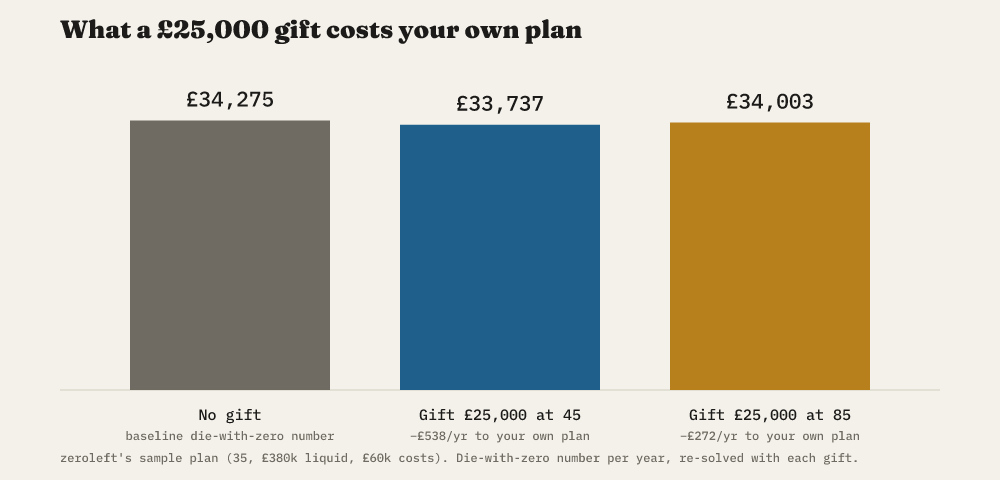
That's not an argument against giving early — it's the real size of the trade-off, and it's small either way: even the costlier timing gives up under 2% of the yearly top-up. The book's case for 45 over 85 was never about what it costs you. It's about what forty extra years of use are worth to the person receiving it — something your own plan can't see, and doesn't need to in order to hold up.
Planning a gift instead of guessing
Deciding to give earlier is the easy part; sizing the gift so it does not undermine your own plan is the part worth getting right. zeroleft's planner lets you place a gift at a specific age, checks it against the book's 26–35 window, and re-solves your die-with-zero number around it — so you can see what a given gift costs the rest of your plan before you commit to it, not after.
Run it on your plan
zeroleft is a free planner that puts a planned gift into your actual numbers: your assets, your income, your costs, and the age you have in mind — so you can see what it does to your die-with-zero number and whether your plan still holds up afterwards.
It is a planning aid, not financial, tax or legal advice, and it's an independent tool — not affiliated with or endorsed by Bill Perkins or the publisher.
Common questions
What age does Die With Zero say to give your kids money?
Between 26 and 35 — old enough to handle money responsibly, young enough for it to still change the path they take. It's the book's suggested window, and it's the range zeroleft checks a planned gift against.
Why not just leave it to them when I die?
Survey data puts the typical age people actually inherit anything at around 58 — well past the decade the book argues the money would do the most good. The point isn't never to leave an inheritance, it's that timing changes what the same amount can do.
Won't giving early mean I have less for myself?
It should come after your own plan holds up, not before. A gift is irreversible in a way your own spending isn't, so it only makes sense once your survival threshold and the rest of your numbers are already sound.
zeroleft turns this into a plan you can act on — free, and the numbers run in your browser.
Start your plan →