The Die With Zero method, explained

Most financial planning is built to answer one question: will my money last? By that standard, reaching the end of your life with several hundred thousand still in the account is a success. Die With Zero, the 2020 book by Bill Perkins, argues that this is the wrong target. That unspent pile is years of your life — the hours you worked to earn it — that you never converted into anything. The book's goal is to reach the end with close to nothing left, because the money did its job.
This is a summary of what the method actually asks you to do, and where it needs care.
The core claim: money is stored life
Every amount you have was earned by spending time. If you die with it unspent, that time bought nothing. Perkins' framing is that your job is not to maximise your net worth but to maximise the experiences your money and health can produce across your whole life — and then to run the balance down deliberately.
That has a shape. Instead of net worth that climbs and plateaus, a die-with-zero plan has net worth that rises to a peak somewhere in mid-life and is then drawn down on purpose: spent, given away, or converted into guaranteed income. The end point is near zero.
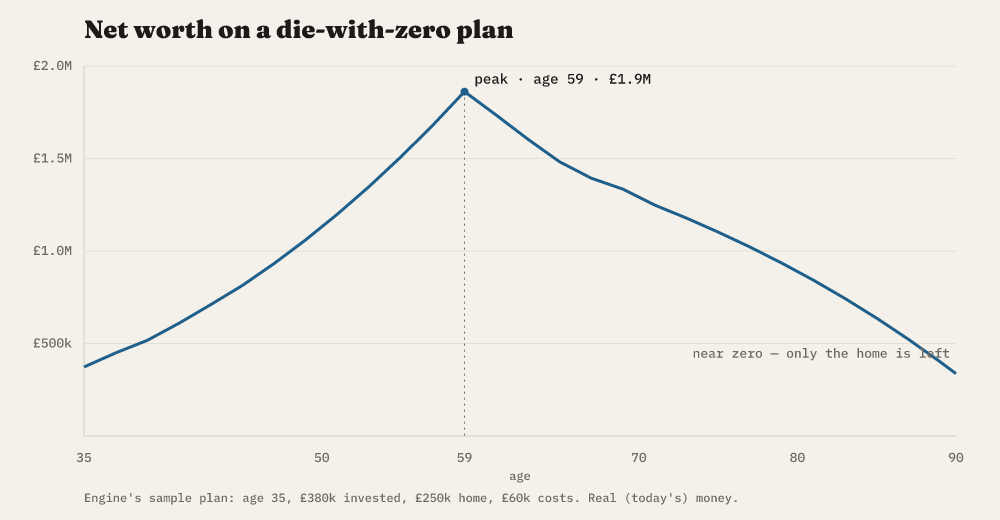
That curve is zeroleft's built-in sample plan — a 35-year-old with about £380,000 invested, a £250,000 home and £60,000 of yearly costs. Left alone, that portfolio would grow to several million by 90. The die-with-zero version spends the surplus down instead.
Spend on experiences while your health can carry them
The book's second idea is that money and health and time are rarely all abundant at once. Young, you have time and health but little money. In peak earning years you have money and health but little time. Later you have money and time but declining health.
So experiences have a shelf life. A trek you can do easily at 50 is harder at 65 and off the table at 80. The value of an experience isn't just its cost — it's what your body and circumstances at that age let you get out of it. The method pushes you to front-load experiences into the decades where your health still supports them, rather than deferring everything to a retirement that arrives with a worse body.
There's a compounding effect the book calls the memory dividend: an experience keeps paying you back in recollection for years afterward, so doing it earlier gives it more time to pay. We cover that separately.
Give money while it still changes something
If you plan to leave an inheritance, the book's question is: why wait? Money given to your children in their late twenties or thirties — when they're deciding where to live, whether to start a business, whether to have kids — can change the path they take. The same amount arriving when they're 60 mostly rearranges their own retirement account. The app checks gifts against the book's suggested window of ages 26–35 for this reason.
Same logic for charitable giving: a donation now does work now.
Insure against a long life; don't hoard against it
The obvious objection to spending down is: what if I live to 100? The book's answer is not "so save more forever" — that's the over-saving trap again. It's to buy longevity insurance. An annuity converts a lump sum into income for as long as you live, which turns an unknowable planning horizon into a known floor. Once you have that floor, you can spend the rest down without the fear.
Where the method needs care
- It assumes you can enjoy spending. Some people get genuine security from a buffer, and forcing the number to zero can cost more peace of mind than it's worth. Treat "zero" as a direction, not a target to hit exactly.
- It has no tax model, and neither does zeroleft. Drawdown order and tax treatment matter a lot in practice; this is a planning aid, not a withdrawal strategy.
- Health and lifespan are uncertain. The health curve is an assumption. The point isn't the precise number — it's that the direction of the effect is real and most people plan as if it isn't.
- Markets are uncertain too. A spend-to-zero plan that ignores sequence-of-returns risk can leave you short after a bad decade early in the drawdown. Any serious version of this needs a safety floor and a stress test, not a single straight-line projection.
Running it on your own numbers
The book is the philosophy. Applying it means arithmetic that's tedious and easy to get wrong by hand. zeroleft is a free planner that does it for you:
- Build a die-with-zero plan for your finances — your assets, income and costs turned into a net-worth path that peaks and comes back down.
- See how much more you can spend. The solver finds your die-with-zero number: the largest amount you can add to your spending every year and still land near zero, with a safety floor kept back.
- Budget your experiences into time buckets. Place the trips and the time with people into windows of your life, against the health you're likely to have then.
- Plan gifts to your children at the right age — inside the window where the money changes a path — and see what each one does to the rest of the plan.
- Run risk simulations. A Monte Carlo across thousands of market paths gives you the real chance of running out, and shows what an annuity buys back.
- Check in once a year to see how you're actually tracking against the plan, and re-solve when life changes.
zeroleft is a planning aid, not financial advice, and it's an independent tool — not affiliated with or endorsed by Bill Perkins or the publisher. Every assumption behind the calculations is written down on the methodology page.
Common questions
Does Die With Zero mean spending recklessly?
No. It keeps a floor for basic needs and treats running out early as the failure to avoid. What it argues against is the opposite failure: dying decades later with a large, unspent pile you worked years to build.
What is the die-with-zero number?
The largest flat amount you can add to your spending every year such that your liquid assets are drawn down to about zero by the end of your planning horizon, with a safety floor kept back.
Is zeroleft affiliated with Bill Perkins?
No. zeroleft is an independent tool built on the ideas in the book. It is not endorsed by the author or publisher.
zeroleft turns this into a plan you can act on — free, and the numbers run in your browser.
Start your plan →