How to calculate your die-with-zero number

Your die-with-zero number is the largest fixed amount you can add to your spending every year and still draw your savings down to roughly nothing by the end of your life. It is not one formula. The floor beneath it is — Bill Perkins gives you that in a single line — but the number itself depends on what you own, what it earns, and how long you live, so it is found by testing rather than solved by hand.
Here is how the calculation works, and why the honest version of it produces a range, not a point.
Start with the floor: the survival threshold
In Die With Zero, Perkins offers one piece of actual arithmetic — the survival threshold, the least you should keep back:
0.7 × the cost to live one year × the years you have left
For someone at 55 planning to 90, with £30,000 of bare annual costs, that is roughly £735,000. Three things are worth knowing about it:
- It is survival, not comfort. "Cost to live one year" means necessities — housing, food, insurance — not the life you actually want to lead. The threshold is the line below which you are in trouble, not a spending goal.
- The 0.7 is a haircut. It discounts your full annual costs, on the reasoning that you will not spend every year at your peak rate, and it keeps the figure conservative without being paralysing.
- It is a rule of thumb, not a model. The formula is meant to be easy to apply and roughly right, not precisely calculated. Treat it as a backstop.
The survival threshold is what stops the rest of the calculation from spending you into a corner. It is not the answer to "how much can I spend" — it is the boundary that answer has to respect.
The number itself: the largest sustainable top-up
Your baseline plan already covers your normal living costs. The die-with-zero number is what you can add on top — a flat amount in today's money, the same every year — such that:
- every year of the plan is funded,
- your liquid assets, meaning cash and investments, land at about zero by your horizon,
- the survival-threshold floor is still intact at every point along the way.
There is no closed-form solution for that amount. Change the top-up and the whole path of your savings changes: how much stays invested, how much it earns, when it runs out. So a planner searches for it — pick a figure, project the plan year by year, check whether you end above or below zero, adjust, and repeat until it settles. zeroleft does this with a binary search; the mechanics are on the methodology page.
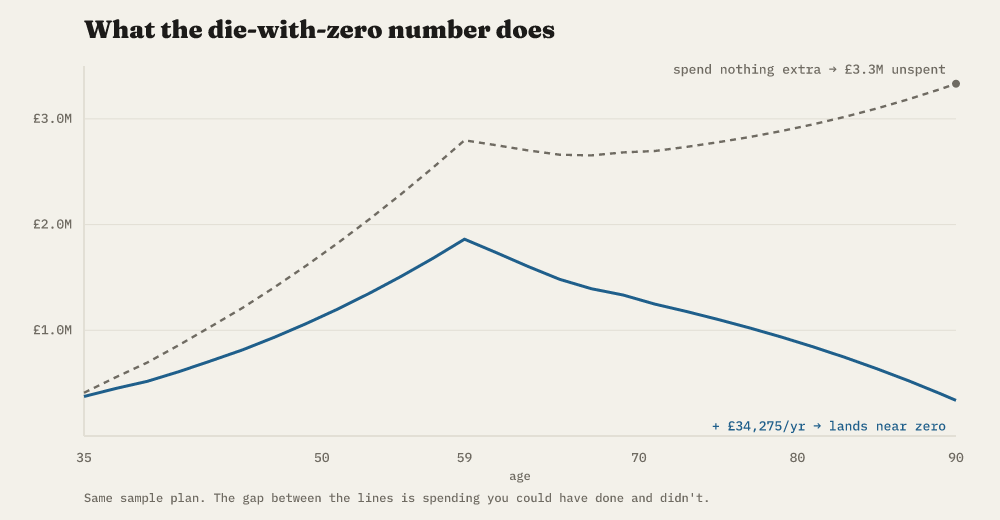
For zeroleft's sample profile — a 35-year-old with roughly £380,000 invested, a £250,000 home and £60,000 of yearly costs — the solver returns about £34,275 a year. Spending that on top of the baseline is the difference between dying with £3.3 million untouched and drawing the account down to nothing.
"Land near zero" refers to your liquid assets only. A home you do not plan to sell is not part of the number — whatever it is worth at the end shows up as unspent. If you do intend to sell it and live off the proceeds, mark it as an asset you will draw down; otherwise it sits outside the calculation.
Why one number is not enough
A calculator that assumes a fixed return every year will hand you a single confident figure. That figure is fragile.
The reason is sequence-of-returns risk: when you are drawing an income from a portfolio, the order of good and bad years matters, not just the average. Two people with the same average return over 30 years can end up in very different places if one has a bad decade early — they sell more of their holdings into a falling market and never fully recover. A straight-line projection cannot see this, which is why it matters most in the years just after you stop earning.
The honest version of the calculation runs many scenarios — varying the returns, sometimes the lifespan — and reports the number as a probability: at this spending level, some share of paths run out before the end. You then choose a level of caution you can live with. A single die-with-zero number is the middle of that distribution; the useful output is the spread around it, and what brings the failure rate down — a smaller top-up, a later start, or converting part of the pot into guaranteed income.
The number is flat; the spending doesn't have to be
The die-with-zero number is deliberately a flat figure, because that makes the plan legible. But the book's argument is to spend more in the decades when your health can still make use of it, and less later. An experience also keeps paying back in memory for years, so the same trip is usually worth more earlier.
Treat the flat number as a budget, not a timetable. If it works out at £18,000 a year of extra spending, that is around £540,000 over 30 years to place where it does the most good — weighted toward the years you will physically get the most from it, rather than spread evenly to the end.
By hand, or with a solver
You can get the shape of this in a spreadsheet: a column per year, your assets growing at an assumed rate, your spending coming out, and you nudge the spending figure until the final balance sits near zero. That is a useful exercise and worth doing once.
What a spreadsheet does not do well is the search — re-solving every time you change an input — and the stress test. For those, a tool that runs the projection thousands of times is the difference between a number and a number you can rely on. There is a fuller comparison in a spreadsheet or a solver.
If you just want the rough figure without opening a spreadsheet or the full planner, the free die-with-zero calculator runs this same search on a handful of inputs, no login required. Or see it already worked out for common amounts and ages on the retire-on pages.
Run it on your numbers
zeroleft does the calculation described here: enter your assets, income and costs, and it finds your die-with-zero number, keeps the survival-threshold floor back, shows the net-worth path that number implies, and stress-tests that path against thousands of market scenarios so the chance of running short is something you can see — along with what an annuity buys back.
It is a planning aid, not financial advice, and it has no tax model, so enter returns net of fees and tax. Every assumption behind the numbers is on the methodology page.
Common questions
What is the survival threshold in Die With Zero?
Bill Perkins' rule of thumb for the least you should keep back: 0.7 × your yearly cost of living × the years you have left. It covers bare survival, not the life you want, and it is meant as an easy rule of thumb rather than a precise figure.
What does it mean to die with zero?
To reach the end of your planning horizon with your liquid savings — cash and investments — drawn down to roughly nothing. A home or other assets you don't intend to sell aren't part of that figure.
Can I calculate my die-with-zero number with a formula?
Only the floor. The survival threshold is a formula. The amount you can safely spend on top of it depends on your assets, your returns and how long you live, which is a search across many scenarios rather than a single equation.
zeroleft turns this into a plan you can act on — free, and the numbers run in your browser.
Start your plan →