The memory dividend: why an experience keeps paying you back

A memory dividend is what an experience pays you back after it's over. You don't just get the enjoyment once, in the moment — you get it again, in smaller doses, every time you recall the trip, tell the story at dinner, or see a photo that brings it back. Bill Perkins coined the phrase in Die With Zero to make one point: an experience earns you twice, and the earlier you have it, the more years it has to keep paying. Some summaries of the book describe this same shift — spending money to create lasting value rather than to own things — as converting financial capital into experience capital; it's the same idea under a different label, not a separate concept from the book.
What actually produces the dividend
The book's version is simple: you have an experience, you enjoy it once, and then you get to relive it — through memory, through retelling, through a photo that surfaces it — for the rest of your life. Perkins' framing is that this recurring payoff is part of the experience's real value, not a sentimental bonus on top of it.
That matches what the research on nostalgia finds, independent of the book. Recalling a positive personal memory reliably produces a real, present-tense boost in mood — it isn't just remembering that you were happy, it's a smaller version of the feeling itself. Sharing the story does more of the same: retelling turns a private memory into a moment of connection with whoever is listening, which is its own small experience layered on top of the original one.
Why earlier is worth more
If an experience keeps paying for as long as you're alive to recall it, then the number of years it has left to pay depends entirely on when you have it. The same trip at 30 has roughly twice as many years to compound as it does at 60. This is the timing argument behind front-loading experiences into the decades your health can still carry them rather than saving them for a retirement that arrives with a worse body: it isn't only that you can do more at 30, it's that whatever you do starts paying immediately and keeps paying longer. See what that actually looks like for your own age and horizon on life in weeks — every week you have left, laid out as a grid.
The same logic is why the book pushes giving money to your children earlier rather than later — a gift lands as an experience (or the chance to have one) at an age when it still has decades to be recalled, rather than arriving as an inheritance that mostly just sits in an account.
What the research actually shows
Two findings hold up outside the book, and it's worth being precise about what they do and don't establish.
Experiences make people happier with their spending than possessions do. In a national survey, people were far more likely to say a past experiential purchase made them happier than a past material purchase of similar cost — 57% versus 34% — and they reported mentally revisiting the experience more often than the object (Van Boven & Gilovich, 2003). That's evidence for spending on experiences generally; it doesn't by itself prove a compounding "dividend" over time.
For that, the more relevant finding is about nostalgia specifically: recalling positive personal memories helps sustain psychological wellbeing as people age, and this effect holds up across the adult lifespan rather than fading out (Hepper et al., 2021, Emotion). That's real support for "an experience keeps paying you back," attributed correctly to research on memory and ageing, not to anything zeroleft calculates.
Where the idea needs care
- It's a heuristic, not a currency. zeroleft does put a number on it — a lifetime-value index that scales the enjoyment of an experience by the years of recall it has left — but that index only exists to compare the same experience at different ages. It isn't money, and it isn't something you solve for; the die-with-zero number is the actual figure the planner produces.
- The payoff isn't flat or guaranteed. Nostalgic memories don't stay simply pleasant — they tend to grow more bittersweet with distance, and how vividly one pays out depends on how it's recalled and how often it's shared. An experience nobody hears about and you never think of again collects less than the book's framing implies.
- It can rationalise present bias. "It'll pay dividends for decades" is also what someone says to justify a trip they can't really afford. The timing argument only holds once the spending itself is sound — the survival threshold and the rest of the plan still have to hold up first.
Turning it into a plan
The practical use of this isn't a calculation — it's a place to put it. zeroleft's planner lets you budget experiences into time buckets: windows of your life, weighted toward the years your methodology models you as having the health and time to make the most of them, rather than spread evenly or pushed to the end.
Here is the same trip — a three-week journey you'd rate 4 out of 5 — dropped into four different decades of a life planned to 90:
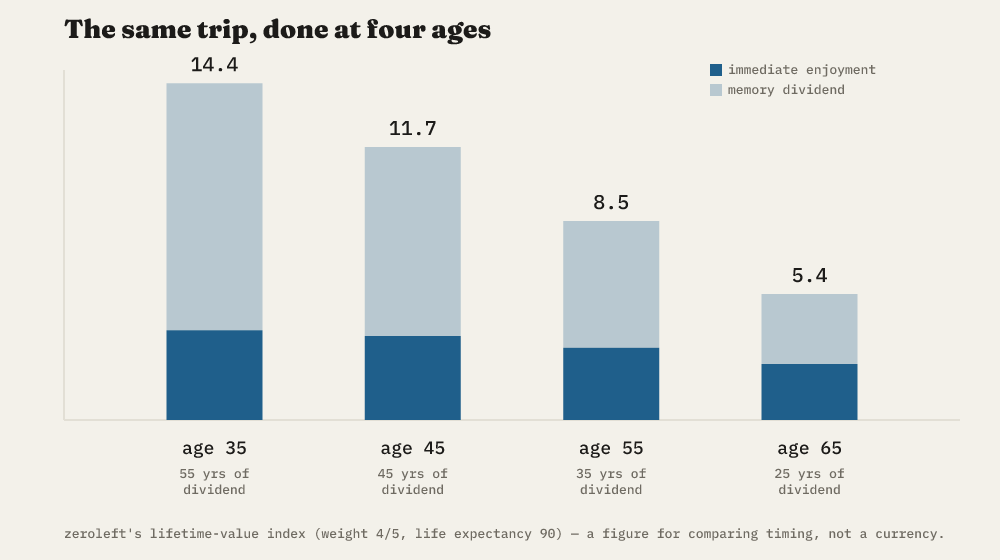
The immediate enjoyment barely changes between 35 and 55 — your health still carries the trip. What collapses is the memory dividend: at 35 it has 55 years to pay out, at 65 only 25. On this model the trip is worth about 70% more at 35 than at 55, almost entirely because of when you do it.
Run it on your own plan
zeroleft is a free planner that puts this into your numbers: budget the experiences you want against the years you're likely to have the health for them, alongside the die-with-zero number that says what you can actually afford to spend on them.
It is a planning aid, not financial advice, and it's an independent tool — not affiliated with or endorsed by Bill Perkins or the publisher.
Common questions
What is a memory dividend?
The payoff an experience keeps paying after it ends. Every time you recall it, tell someone about it, or get reminded of it by a photo or a smell, you get a small hit of the original enjoyment again — for free, for years.
Did Bill Perkins invent the term memory dividend?
He coined the phrase in Die With Zero (2020). The underlying idea — that recalling and retelling a past experience produces real, measurable positive feeling — is older and comes from psychology research on nostalgia and nostalgic memory, not from the book.
Does zeroleft calculate my memory dividend?
Not as a currency. The planner does compute a lifetime-value index — the enjoyment of an experience scaled by the years of recall it has left — but only to compare the same experience done at different ages. It's a reason to front-load experiences into the years your health can carry them, and the planner's time-buckets feature is where you place them.
Is experience capital the same as the memory dividend?
Yes — same idea, different label. Experience capital is how some summaries of the book describe converting money into lasting value through experiences rather than possessions; the memory dividend is the specific mechanism (recall and retelling) that makes that conversion pay off over time.
zeroleft turns this into a plan you can act on — free, and the numbers run in your browser.
Start your plan →