Is Die With Zero a bad idea? The criticisms, honestly

No, but several of the specific criticisms are correct, and worth taking seriously before you follow the method literally. The sharpest one is this: the number that reaches zero is also the riskiest number you could pick, by construction. Below is where each major criticism actually lands, checked against zeroleft's own solver and sample plan rather than argued in the abstract.
The strongest criticism: spending to zero removes your margin
The most common technical objection, raised by outlets from White Coat Investor to Early Retirement Now, is that a plan sized to hit zero by a fixed date has no cushion left for a bad sequence of market returns. Sequence-of-returns risk — the fact that when a downturn happens matters as much as its size — hits a spend-down plan harder than one that's still accumulating, because there's less time left for a recovery to arrive before the money's needed.
This criticism is correct, and zeroleft's own die-with-zero number demonstrates it rather than hiding it. The solver finds the largest flat amount you can add to your spending such that liquid assets land at roughly zero by your horizon, assuming one fixed average return every year. That's the mathematical edge of feasible — not a number with room in it. Run the same plan through a Monte Carlo stress test instead of one assumed average, and the risk is visible:
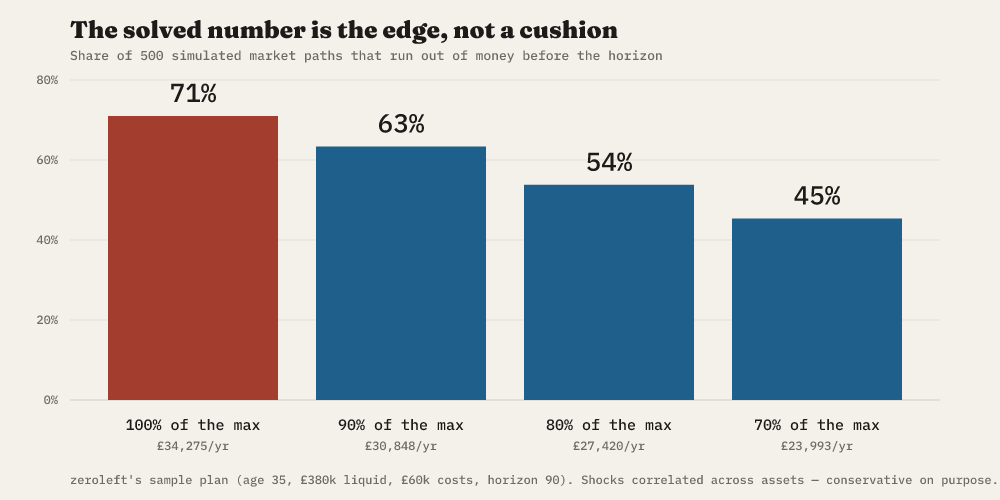
At the full solved number — £34,275 a year on top of the sample plan's £60,000 of living costs — 71% of 500 randomised market paths run dry before the plan's horizon of 90. Spend 10% less and that drops to 63%. At 70% of the solved number it's 45%. None of those are low; this simulation deliberately correlates a market shock across every asset in a given year, which overstates real-world risk on purpose. But the shape of it makes the critics' point directly: the solved number is the edge, and every step back from it buys real margin.
"Doesn't the survival threshold protect you?" Not automatically
The book's own backstop is what zeroleft calls the survival threshold: a floor equal to 0.7 × your yearly cost of living × years remaining, described on the methodology page. Several people reasonably assume this means the solver keeps your liquid assets above that line throughout the plan.
Checked directly against the engine and the sample plan on 2026-09-16: it doesn't, at least not as an automatic constraint. In that plan, the survival threshold at age 35 works out to roughly £2,352,000 — 0.7 × £60,000 × the 56 years remaining to 90 — while the solved plan's actual liquid assets at that age are about £404,000. The solver's search only checks that no year is left completely unfunded; it doesn't stop early to preserve the threshold figure. That's not a bug so much as what the formula is for: at a young age with decades left, 0.7 × years-remaining is a huge number precisely because it assumes no further income and no growth at all, which isn't the situation the solver is optimising for. Read the threshold as a yearly comparison point, not a guarantee the solved number respects on its own. If this distinction matters to you, spend below the max — as the chart above shows, that's what actually moves the odds.
What critics get right about the book itself
Bill Perkins is a hedge fund manager and professional poker player, and several reviewers, including White Coat Investor, point out that his examples — chartering flights for a birthday, six-figure trips — don't transfer to an average saver's life. That's a fair criticism of the book's tone, separate from whether the underlying idea holds up. The book is also, by its own design, a philosophy rather than a spending plan: it argues for the direction (spend down, don't hoard) without giving you the arithmetic to apply it to your own numbers. That gap is real, and it's the reason a model exists at all rather than a rule of thumb.
Where zeroleft doesn't close the gap either
Some criticisms of "spend it down" apply just as much to zeroleft's model as to the book, and it's worth saying so plainly rather than implying a tool fixes what a philosophy can't:
- No tax model. Drawdown order and tax treatment can change what's actually safe to spend, and neither the book nor zeroleft accounts for it.
- One person. The data model has room for a partner; the calculations don't use it yet. A joint retirement's risks (one partner outliving the other, unequal health declines) aren't represented.
- No long-term care cost. A large, late-life care bill is exactly the kind of shock a spend-to-zero plan has the least room to absorb, and it isn't modelled separately from ordinary living costs.
The annuity isn't an automatic fix
The book's answer to "what if I live longer than planned" is to buy longevity insurance: an annuity converts part of a lump sum into income for life, which is why zeroleft models annuities alongside the Monte Carlo. It's tempting to assume buying one straightforwardly fixes the risk shown above. Tested against the same sample plan, it doesn't, at least not by default: adding a £100,000 annuity at age 65 with a 6.5%, non-inflation-linked payout, at the same £34,275 spend, moves the modelled chance of running short from 71% to 70% — barely anything. The premium comes out of assets that would otherwise keep compounding, and a level nominal payout loses real value to inflation for decades before it's needed most, in the plan's later years. A larger annuity, one bought against essential costs specifically, or an inflation-linked payout could move the number further — the point is that buying one doesn't automatically fix the number above, so it's worth testing your own case rather than assuming.
This also helps explain the "annuity puzzle" — economists' long-standing observation that far fewer retirees buy annuities than the theory says they should. Cost, illiquidity, and a level payout that erodes with inflation are real downsides, not just behavioural reluctance.
So where does that leave the philosophy?
Not disproven — but the honest version of Die With Zero isn't "spend the biggest number the maths allows." It's: find that number so you know where the edge is, then choose to spend meaningfully less than it, and check what that actually does to your odds instead of guessing. zeroleft runs both halves of that — the solve and the stress test — on your real numbers, including what an annuity does or doesn't buy back for your specific plan.
zeroleft is a planning aid, not financial advice, and has no tax model. It's an independent tool, not affiliated with or endorsed by Bill Perkins or the publisher.
Common questions
Is Die With Zero a bad idea?
Not inherently, but several specific criticisms of it are correct. The book argues for spending down to near zero by the end of your life; the riskiest version of that is spending the largest amount you mathematically could, which is exactly what a bare die-with-zero number is. Treat the number as the edge of what's feasible, not a target to spend right up to.
What are the main criticisms of Die With Zero?
That it removes your margin exactly when a bad run of markets could hurt you most (sequence-of-returns risk); that its examples and tone come from a very wealthy author and don't transfer to an average saver; and that it's a philosophy, not a spending plan, so turning it into an actual number needs a model the book doesn't provide.
Does the survival threshold stop you from running out of money?
Not automatically. It's a reference figure zeroleft reports each year — 0.7 times your yearly cost of living times years remaining — but the die-with-zero solver doesn't stop at it. Left at the solved number, your liquid assets can and do sit below that figure for most of the plan. It's a sense check to read, not a floor the solver enforces for you.
zeroleft turns this into a plan you can act on — free, and the numbers run in your browser.
Start your plan →