Retirement drawdown strategies, compared
Four broad strategies exist for turning a portfolio into retirement income: withdraw a fixed percentage, withdraw a rate that adjusts within guardrails, spend the account down to zero over a fixed horizon, or convert part of it into an annuity. None of them is safe by default — each trades certainty against how much you get to spend, in a different place. Here is what each one actually does, where the historical evidence for it comes from, and where it breaks.
The 4% rule: fixed withdrawals, sized for the worst case
Withdraw 4% of your starting balance in year one, then take that same dollar amount every year after, adjusted only for inflation. The figure comes from William Bengen's 1994 analysis of historical US market returns, later popularised as the Trinity study in 1998: across rolling 30-year periods, a 50/50 stocks-and-bonds portfolio withdrawing 4% (inflation-adjusted) essentially never ran out.
The rule is conservative because it has to survive the worst 30-year stretch in the data, not the average one. In most other periods, a 4% withdrawal leaves the portfolio larger at the end than it started — a lower, fixed rate applied to good decades tends to leave several times the starting balance unspent by year 30. That's the trade you're making: a high floor of certainty, bought with money that, most of the time, goes unused.
It also assumes a 30-year horizon. Retire at 45 rather than 65 and you may need the money to last 50 years, which the original analysis wasn't built for — Vanguard has argued for a lower or dynamically adjusted rate for early retirees for exactly this reason.
Guardrails: a variable rate that reacts to your portfolio
Rather than fixing the withdrawal amount for three decades, the guardrails approach — developed by Jonathan Guyton and William Klinger in 2006 — starts higher (research commonly cited puts it around 5%) and then adjusts: spending is cut by a set percentage when the withdrawal rate drifts above an upper guardrail (the portfolio has fallen), and raised when it drifts below a lower one (the portfolio has grown).
The appeal is a higher starting income for a similar or lower chance of running out — one comparison of the two methods over the same historical data put the fixed 4% rule's failure rate at roughly 1 in 7 thirty-year periods, against a small fraction of that for a guardrails plan. The cost is variability: guardrails can mean a real cut to spending in a bad early stretch, and critics of the method point out that the same rules which prevent running out also tend to bank more unspent money than necessary in the scenarios that don't go badly, for the discomfort of the cuts in the scenarios that do.
Spend-to-zero: draw down to a fixed horizon on purpose
The Die With Zero method drops the goal of preserving capital entirely. Instead of a rate applied to an indefinite horizon, it sets a fixed planning horizon — your expected lifespan — and finds the largest flat amount you can add to your spending so that liquid assets land at roughly zero by the end of it, while never dropping below a survival-threshold floor along the way. We cover how that number is actually calculated separately.
This is the approach zeroleft's solver runs. The trade-off is the mirror image of the 4% rule's: a shorter, known horizon lets you spend more of what you have while you're able to use it, at the cost of the safety margin an indefinite-survival plan builds in. Get your lifespan estimate badly wrong in either direction and the plan either falls short or, like the other strategies, leaves money unspent.
Annuitising: buy a floor, keep the rest flexible
Converting part of a portfolio into an annuity trades a lump sum for guaranteed income for as long as you live, which turns an unknowable planning horizon into a known one for that portion of your spending. Advisers commonly frame it as splitting expenses into essential costs — covered by the guaranteed income — and discretionary spending, funded from whatever stays invested.
The guarantee is real, and it removes longevity risk entirely from the annuitised portion. It's also the least flexible of the four: once bought, most annuities can't be unwound for their cash value, and the income is fixed regardless of what you'd rather do with the money later. It also costs something — insurers price in their own margin and the risk they take on, so an annuitised dollar generally buys less expected lifetime income than the same dollar invested and drawn down, in exchange for the certainty.
What none of these show you by themselves
Every one of the four, described as above, is a single scenario: one assumed return, one assumed lifespan, one path. What actually determines whether any of them holds up is sequence-of-returns risk — the order your returns arrive in, not just their average. A portfolio that loses 30% in the first two years of a fixed 4% withdrawal is in a very different position than one that loses the same 30% in years 28 and 29, even though the long-run average return is identical. Schwab's explanation of why timing matters more than the average applies equally to a 4% plan, a guardrails plan, or a spend-to-zero plan — none of them are exempt from it, and a single straight-line projection can't show it to you at all.
The honest version of any of these strategies runs the plan across many possible market paths, not one, and reports a chance of running short rather than a single confident number. That's true whichever strategy you're testing — the strategy decides how you'd respond to a bad sequence; the stress test is what tells you how likely one is.
Run zeroleft's own sample plan — £380,000 liquid, £60,000 of yearly costs, a horizon to 90 — through the spend-to-zero solver and the gap between a number and a number you can rely on gets concrete fast.
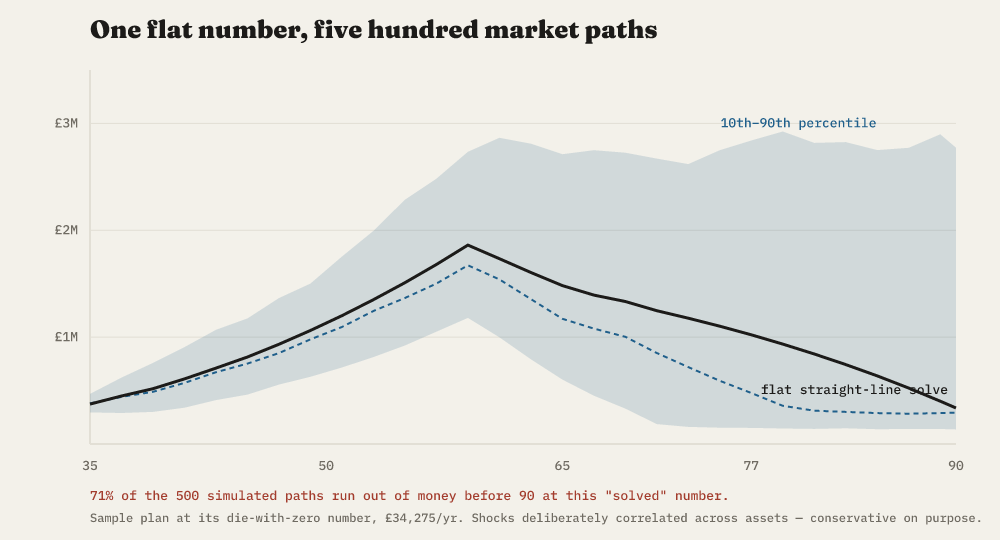
The flat solve looks confident: £34,275 a year, landing at exactly zero on schedule. Run the identical plan five hundred times with randomised yearly returns instead of one assumed average, and 71% of those paths run dry before 90 — the flat number is the exact edge of feasible, not a cushioned estimate. (The 4% rule, applied to the same £380,000, would hand this plan just £15,200 a year — conservative because it's sized to preserve the pot indefinitely rather than spend it to zero by a known horizon, and because it doesn't count the salary running to 59 or the pension from 67 that the solver does.)
zeroleft doesn't yet simulate a guardrails-style variable withdrawal the way it models a flat spend-to-zero number — that's a real gap in the tool, not a claim being made here. What the chart above shows is the point every strategy in this guide shares: a single scenario, whichever rule produced it, tells you nothing about how it fails.
Choosing between them
None of the four is more correct than the others — they optimise for different things:
- The 4% rule if you want a fixed, predictable income and are willing to likely leave money unspent in exchange for not having to watch or adjust anything.
- Guardrails if you can tolerate a spending cut in a bad early stretch in exchange for a higher starting income the rest of the time.
- Spend-to-zero if your priority is using what you have within a horizon you're willing to plan against, rather than preserving a balance indefinitely.
- Annuitising, in part or in full, if certainty of income matters more to you than flexibility or expected value — most often used to cover essential costs, alongside one of the other three for the rest.
Combining them is common in practice: an annuity for the survival-threshold floor, a spend-to-zero or guardrails approach for the rest.
Stress-test whichever one you're considering
zeroleft runs the spend-to-zero version of this: it finds the largest flat amount you can add to your spending and still land near zero by your horizon, keeps a survival-threshold floor back, and stress-tests that number against thousands of market paths — including what buying an annuity for part of the floor does to the chance of running short.
zeroleft is a planning aid, not financial advice, and has no tax model. It is an independent tool, not affiliated with or endorsed by Bill Perkins, the publisher, or any of the researchers or firms named here.
Common questions
What is the safest retirement withdrawal strategy?
None of the four compared here is safe in an absolute sense — every one of them can run short in a bad enough sequence of markets. The 4% rule is the most conservative by design: it's sized to survive close to the worst historical 30-year stretch, which is also why it tends to leave the most money unspent. Guardrails and annuitising both trade some of that margin for either more income or more certainty of income, in different ways.
Is the 4% rule outdated?
It's dated to a specific set of assumptions — a 30-year US retirement, a 50/50 stocks-and-bonds portfolio, a fixed real withdrawal. Outside those assumptions (a longer retirement, a different market, a willingness to flex spending) it's either too conservative or not conservative enough. It's still a reasonable starting estimate, not a rule to follow literally.
What is the guardrails withdrawal strategy?
A dynamic alternative to the 4% rule: start at a higher withdrawal rate, then adjust it up or down when your portfolio drifts outside a defined range, instead of holding the amount fixed for 30 years. It's built to spend more of the time you actually have, at the cost of a spending cut if markets turn against you early.
zeroleft turns this into a plan you can act on — free, and the numbers run in your browser.
Start your plan →