Die With Zero vs. FIRE: are they the same plan?
FIRE (Financial Independence, Retire Early) and Die With Zero aim at the same pool of money from opposite directions. FIRE is built to answer will I run out? — its whole apparatus (the savings rate, the 4% rule, the buffer) exists to make the answer no, for good, even in a bad market. Die With Zero is built to answer a different question — will I die with money and years I never used? — and treats a large unspent balance at death as a failure of its own. Neither is wrong. They're solving for different things, and most people need both at different points in their life.
What FIRE actually optimises for
FIRE traces back to Your Money or Your Life, Vicki Robin and Joe Dominguez's 1992 book that reframed spending as traded life-hours — the same "money is stored time" idea Bill Perkins later built Die With Zero around, aimed at the opposite end of the timeline. The FIRE community built a specific method on top of it: save a high fraction of income — often 50% or more — invest the surplus, and stop working once your portfolio can fund your spending indefinitely.
"Indefinitely" is doing the work in that sentence. The standard FIRE number is 25× your annual spending, derived from the "4% rule": withdraw 4% of your starting balance each year, adjust for inflation, and — per the 1998 Trinity study, which formalised the idea William Bengen had proposed a few years earlier — a portfolio of mostly stocks and bonds has historically survived 30 years of that at a high success rate. Retiring at 35 rather than 65 stretches the horizon well past 30 years, which is why Vanguard's own research argues the standard 4% figure needs adjusting downward for early retirees — a lower or dynamically adjusted rate, for a wider safety margin.
That margin is the part Die With Zero has a problem with.
What Die With Zero actually optimises for
The Die With Zero method starts from the same kind of arithmetic — a floor, a horizon, a drawdown — but points it at a different target. Instead of a withdrawal rate sized to survive indefinitely, it sets a fixed planning horizon (your expected lifespan) and solves for the largest flat amount you can spend, on top of living costs, so that liquid assets land at roughly zero by the end of it — while never dropping below a survival-threshold floor along the way. We cover the mechanics of that number separately.
The target is the difference. A 4%-rule portfolio is explicitly built to not run out over an unknowable horizon, which in most historical scenarios means it grows, not just holds steady — the terminal value of a 4%-or-lower withdrawal plan is usually well above the starting balance, not just intact. Die With Zero treats that leftover pile as the cost, not the win: years of work converted into money that never bought anything.
Where they clash
FIRE's safety margins are exactly what Die With Zero calls over-saving once you're past your number:
- A conservative withdrawal rate (3–3.5% instead of 4%) sizes the portfolio for the worst realistic sequence of returns — which means it's oversized for every sequence that isn't the worst one.
- A large cash buffer held against a market downturn is money doing nothing while you're alive to spend it.
- "Chubby" or "fat" FIRE — saving well past the number "just in case" — is the pattern the book argues against most directly: the marginal year of saving buys less than the marginal year of your health and time would have.
- A paid-off home held as a hedge, rather than a home you'd actually downsize or release equity from, is an asset Die With Zero would count as unspent at the end, same as any other.
None of this makes FIRE's caution irrational — a bad decade early in retirement is a real risk, not a hypothetical one. It means FIRE and Die With Zero disagree about how much margin is worth holding once you're financially independent, not about whether the underlying arithmetic works.
Where they agree
Strip away the framing and the two movements share more than the debate suggests:
- Both are depletion models, not growth models. The 4% rule is itself a plan to draw a portfolio down over a horizon — it just picks a horizon long enough, and a rate low enough, that the drawdown rarely reaches zero. Die With Zero picks a shorter, fixed horizon and draws closer to it on purpose.
- Both take sequence-of-returns risk seriously, or should. A bad run of markets in the first years after you stop earning does more damage than the same bad years averaged over a whole career, for a FIRE retiree and a Die With Zero spender alike — it's one of the biggest risks to any drawdown plan, whichever number you're spending against.
- FIRE gets you to the start line Die With Zero is written for. The saving-too-much diagnostic that Die With Zero readers eventually hit — money and health both intact, still saving out of habit — is a problem you can only have after years of the FIRE discipline that got you financially independent in the first place.
A practical way to hold both
If you're still accumulating, FIRE's savings discipline is the right tool: it's the fastest route to the point where Die With Zero's argument becomes relevant at all. Once you're at or near your number, the question changes from how do I get there to why am I still banking margin I don't need — and that's the question Die With Zero is actually asking.
The honest version of either plan needs the same missing piece: a real stress test, not a single rate applied by hand. A flat 4% and a flat die-with-zero top-up are both point estimates — neither shows you the spread of outcomes a real sequence of markets could produce. Different ways of drawing down a portfolio are compared here; the mechanics of zeroleft's own solver and its Monte Carlo are on the methodology page.
Run zeroleft's own sample plan — a 35-year-old with £380,000 invested, a salary to 59 and the state pension from 67 — through both lenses, and they don't just disagree on the number. They're answering different questions.
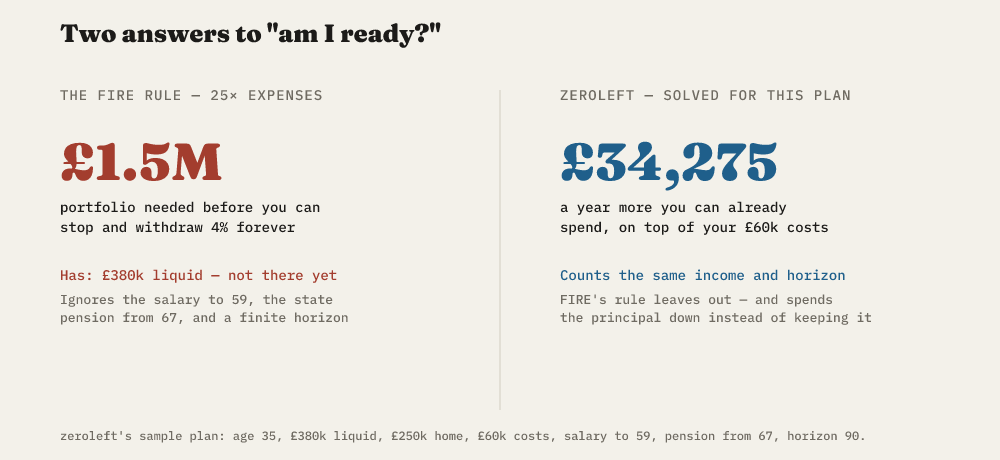
FIRE asks how big a pot do I need to live off the returns forever, and for this profile the answer is no — £380,000 liquid is a quarter of the £1.5 million the 25x rule wants before you're "done." zeroleft asks a different question — given everything coming in, and a horizon that ends at 90 rather than never, what can I add to my spending starting now — and the answer is £34,275 a year of headroom already. Both are internally consistent. They're just not measuring the same thing.
Run your own number
zeroleft doesn't ask you to pick a side. It finds the largest flat amount you can add to your spending and still land near zero by your horizon, keeps a survival-threshold floor back, and stress-tests that number against thousands of market paths so you can see the actual chance of running short — whether you got to this point by FIRE, by accident, or by neither.
zeroleft is a planning aid, not financial advice, and has no tax model. It is an independent tool, not affiliated with or endorsed by Bill Perkins, the publisher, or any FIRE community or author named here.
Common questions
Is Die With Zero the opposite of FIRE?
No, though they're often framed that way. FIRE is mostly about the accumulation phase: save hard, hit a number, stop working. Die With Zero is about what happens after — it argues that the safety margins FIRE builds in (a 3.5% withdrawal rate, a cash buffer, a paid-off home) become their own form of over-saving if you never spend them down. You can follow FIRE to get free, then apply Die With Zero once you're there.
What withdrawal rate does Die With Zero use instead of the 4% rule?
Neither the book nor zeroleft uses a fixed withdrawal percentage. Die With Zero starts from a survival-threshold floor (0.7 × yearly cost of living × years remaining) and then solves for the largest flat amount you can add to your spending and still land near zero by a fixed horizon — a depletion target, not a percentage rule.
Can I do FIRE and Die With Zero at the same time?
Most people effectively do the first, then the second. Aggressive saving is still the fastest way to reach financial independence. Die With Zero's argument only starts to matter once you're at or near your number and still can't bring yourself to spend from it.
zeroleft turns this into a plan you can act on — free, and the numbers run in your browser.
Start your plan →