Am I saving too much for retirement?
Yes, it's possible — but a list of feelings won't tell you if it's you. The only real answer is a number: compare what you have against the most you could spend and still land near zero by the end of your plan. Short of running that, "am I saving too much" is a guess dressed up as a question.
The checklist version of this question
Search this question and you'll mostly get lists of feelings, not numbers. Common items: you're comfortably covering expenses but still cutting spending to save more, you're years past standard age-based savings benchmarks, or you keep delaying things — travel, a purchase, retirement itself — "just in case," even though nothing concrete is threatening the plan. Fear is often named as the tell: not a specific risk you can point to, just a general unease about spending down a balance you spent decades building.
Those signs are real, and worth noticing. But none of them are a number. They describe a mood, not a plan — which is exactly why the checklist version of this question rarely changes anyone's behaviour. Knowing you feel over-cautious doesn't tell you how much slack you actually have.
What the checklists are missing
Die With Zero, the 2020 book by Bill Perkins, makes the sharper version of this argument: money you die with unspent was time you worked and never converted into anything. That's the book's claim, and it reframes the question usefully — not "do I feel like I'm saving too much" but "is there a spendable amount, on top of what I already spend, that I could add without putting my future self at risk."
That amount is calculable. Zeroleft calls it your die-with-zero number: the largest flat sum you could add to your yearly spending and still draw your liquid assets down to roughly zero by the end of your planning horizon, while never dropping below a survival-threshold floor along the way. If that number comes out meaningfully above zero and you're not spending it, you have your answer — precisely, not by feel. If it comes out near zero or negative, the checklist was wrong about you, whatever it felt like. The mechanics of the floor and the solver live on the methodology page; the point here is just that a number exists and a feeling isn't a substitute for it.
Most retirement math assumes your spending never changes. It does.
Part of why the number surprises people is that most retirement calculators hold spending flat in real terms for the whole retirement — pick a yearly figure, adjust it for inflation, hold it steady for 30 years. Research on actual retiree spending says that isn't how it goes. David Blanchett's "retirement spending smile" work, using data from the RAND Health and Retirement Study, found that real household spending typically declines through a retiree's mid-80s before edging back up for late-life healthcare costs — a meaningful drop from the starting level, not a small one, before the late uptick.
That matters here because a flat-spending assumption overstates what you need for the middle stretch of retirement, which is exactly the stretch most savings targets are sized against. If your plan (or a calculator you trust) assumes flat real spending forever, it's structurally biased toward telling you to keep saving — not because your number is wrong, but because the model behind it doesn't match how people actually spend. This is research describing an average pattern, not a guarantee about your own spending; it's a reason to check your specific case, not a reason to assume you're automatically fine.
The pull to keep going past your number
There's a well-documented pattern in the FIRE community called "one more year syndrome": reaching your number and still not stopping. The mechanism behind it is mostly psychological — loss aversion makes the (small) chance of running short weigh more heavily than the certain cost of another year worked — and the financial upside of giving in to it is smaller than it feels. One quantitative estimate: working a single additional year raises your safe withdrawal amount by roughly 7.5–8%, fairly consistently across retirement horizons — a real but modest bump, not the transformation the fear behind it implies. Past a certain point, the next year of saving buys less margin than it costs in time you don't get back — which is the book's core argument, applied to a specific, checkable decision instead of a general mood.
The honest counterpoint: most people asking this aren't oversaving
Here's the part a page selling you on Die With Zero should say plainly: survey evidence says oversaving is the less common regret, not the more common one. A 2026 TIAA Institute survey found that 76% of retirees wish they'd started saving earlier, and 71% wish they'd saved more — roughly three in four, running in the opposite direction from the question this page is about. If you're anxious about your retirement number, the base rate says under-saving is the more likely problem, not over-saving.
That doesn't make the question pointless — it makes it conditional. Oversaving is a real, specific situation: your assets already clear your die-with-zero number with room to spare, and you're still trimming today's spending to add to it. If that's not your situation, the honest answer is that you're probably not the exception, and the more useful question is the standard one — will this be enough — not this one.
How to actually check, instead of guessing
None of this is arithmetic you should do by hand — the survival threshold, a realistic (not flat) spending path, and a genuine stress test against bad market sequences interact in ways that are tedious to get right and easy to get wrong. zeroleft is a free planner that does this for your actual numbers:
- Builds your die-with-zero number from your real assets, income, and costs — not a generic benchmark.
- Keeps the survival-threshold floor back automatically, so the number it gives you isn't reckless by construction.
- Runs a Monte Carlo stress test across thousands of market paths, so you see the real odds of the plan working, not a single straight-line guess. Different ways of drawing a portfolio down, compared, are covered here.
- Lets you re-check once a year as your numbers change, rather than deciding once and wondering forever.
Take zeroleft's own sample plan and run it with no die-with-zero number set at all — just the default instinct to keep saving and see what's left at the end.
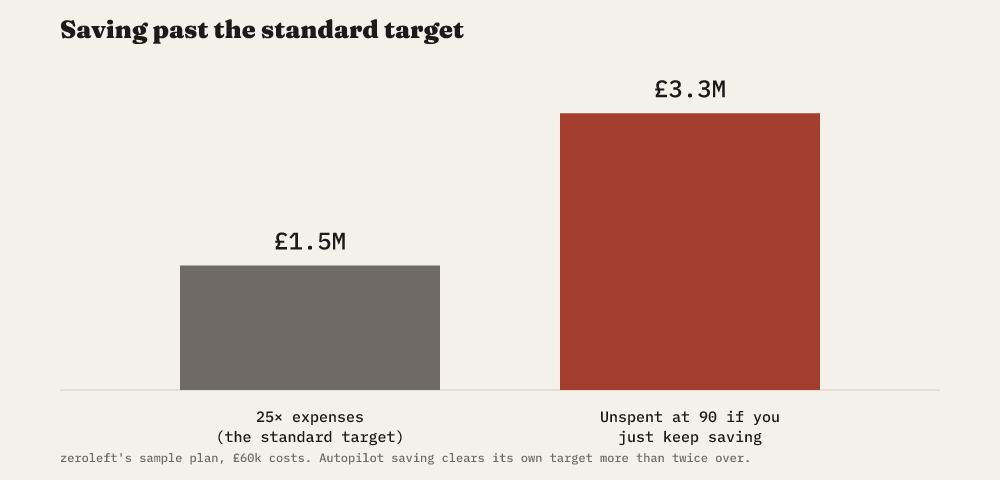
The 25×-expenses rule already says £1.5 million is enough for this plan's £60,000 of yearly costs. Left unmanaged, the same plan sails past that line and finishes with £3.3 million sitting untouched — four extra decades of "just in case" that nobody used. That's the over-saving trap in one chart: clearing the standard target isn't the failure this guide is about. Not noticing you already cleared it, and continuing to save anyway, is.
Run your own number
Whether you're anxious about running out or wondering if you've already cleared the bar, the answer is the same calculation, just read in different directions. zeroleft finds your actual die-with-zero number, keeps a floor back, and stress-tests it — so "am I saving too much" stops being a feeling and starts being a number you can check.
zeroleft is a planning aid, not financial advice, and has no tax model. It's an independent tool, not affiliated with or endorsed by Bill Perkins or the publisher.
Common questions
How do I know if I'm saving too much for retirement?
A feeling isn't enough to tell you. Compare what you already have against your actual die-with-zero number — the most you could add to your spending each year and still land near zero by the end of your plan, with a safety floor kept back. If your current savings rate is well past that number and you're still cutting spending today to add to it, that's oversaving. If you haven't run the number, you don't actually know yet.
Is it common to save too much for retirement?
It happens, but survey data says it's the less common regret. A 2026 TIAA Institute survey found 76% of retirees wish they'd started saving earlier and 71% wish they'd saved more — the opposite complaint. Oversaving is a real, specific failure mode, not the default one, so check your own numbers before assuming it's you.
Does retirement spending really go down as you get older?
On average, yes, before rising again late in life for healthcare. Research from David Blanchett (the 'retirement spending smile') found real spending for a typical household declining from retirement through the mid-80s before an uptick. Standard retirement plans that assume flat, inflation-adjusted spending for the whole retirement can overstate how much you need — which pushes some people toward saving past the point it's actually buying anything.
zeroleft turns this into a plan you can act on — free, and the numbers run in your browser.
Start your plan →