When to take the trips you keep putting off

Some trips need a body that cooperates: a multi-day trek, a dive, a long-haul flight into a demanding itinerary. Others don't. The mistake most bucket lists make is ranking every item the same way — by cost, or by whichever feels easiest to justify this year — instead of by which ones have the shortest window left to say yes. Do the physically demanding trips while your fitness can still carry them. The rest can wait.
Money, time and health rarely show up together
Die With Zero calls this the health line: your physical and mental capacity for a given experience declines with age, and no amount of money buys it back. Young, you typically have time and health but little money. In peak earning years you have money and health but little time. Later you tend to have money and time, but a body that can no longer do everything it used to.
That third phase is where most retirement travel planning quietly goes wrong. Early retirement is usually the most financially cautious stretch — people are still adjusting to spending down a pot rather than adding to it, so the ambitious trip gets pushed to "next year." Travel writers and long-running forum threads for older travellers describe the same pattern from the other side: by the time the money finally feels settled enough to spend without worry, the knees, the altitude tolerance, or the stamina for a long transit have already started setting the terms (Rick Steves Travel Forum; The Points Guy). None of that is a study — it's a widely repeated pattern among people further along than you — but it points the same direction the research on ageing does.
What actually declines, and how fast
The clearest measured version of this is aerobic capacity. VO2max — a standard measure of how much oxygen your body can use during hard effort, a decent proxy for how a trek, a long hike, or a demanding travel day at altitude will feel — falls by roughly 10% per decade after age 25 in the general population. In sedentary adults the decline runs faster, close to 12% per decade in one commonly cited comparison; people who keep training lose it at roughly half that rate (Pollock et al., Journal of Applied Physiology, 1990). That's research, not the book: Perkins' health line is a qualitative argument that capacity declines with age, and this is independent evidence that the direction is real and the slope is gradual rather than a cliff — right up until a specific trip's demands cross what you can still do.
zeroleft's version: a latest good age per trip
Every experience you plan in zeroleft carries a minimum health requirement — how much of your full capacity the trip needs to be worth doing properly — alongside the age you've placed it at. The planner checks that requirement against your health curve and can tell you the latest age it still clears the bar, so a demanding trip doesn't quietly slip from "next year" to "too late" without you noticing.
Here's what that looks like for a trek rated near the top of the enjoyment scale, needing 80% of full health, run against zeroleft's default health curve for someone planning to 90:
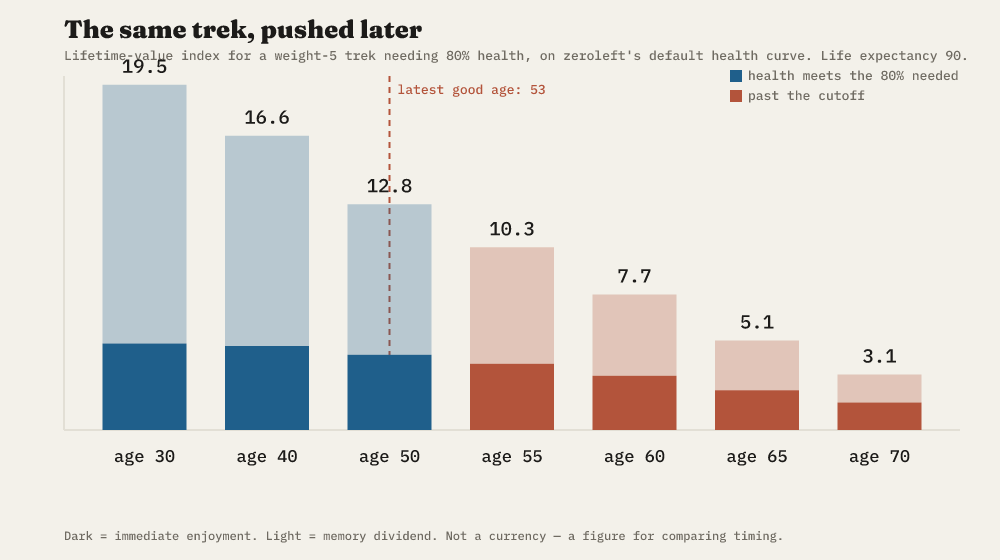
Up to 53, the value drifts down slowly — health is still adequate, so most of the fall is just the shrinking memory dividend from having fewer years left to recall it. Past 53, the model applies a penalty on top of that: once your health falls under what the trip needs, immediate enjoyment drops faster than health alone would suggest, because the experience itself starts asking more than you can comfortably give it. That penalty, and the 80%-health trek used here, are zeroleft's model, not a claim about your specific health — the number to take from this isn't "53," it's that the fall has two different slopes, and the steep one starts exactly where your fitness stops meeting the trip's demands.
Sequencing your own list
A practical way to run this without the planner:
- Tag each item by physical demand, not cost. A multi-day trek, a dive certification, or a long, jet-lagged itinerary belongs in a different bucket from a city break or a cruise, regardless of price.
- Find the ones with a real ceiling. High-altitude trekking, technical diving, and multi-day physical trips are the ones a body can age out of. Wine regions, museums, and most cruises aren't going anywhere.
- Put the ceiling items in the next window, on purpose. If your plan has room, book the demanding trips within the next five to ten years rather than "eventually" — waiting for the budget to feel perfectly comfortable is often waiting past the point your body would have said yes.
- Lay out how much time you actually have left. Life in weeks turns your remaining years into a grid instead of an abstraction, which makes "next year" a lot more concrete.
Where this needs care
- Individual variance is large. Some people trek into their eighties; some lose the capacity for a demanding trip much earlier than the average curve suggests. zeroleft's health curve is a population-level assumption, not a prediction about you — treat the "latest good age" it gives you as a prompt to check honestly, not a verdict.
- This isn't licence to overspend. The financial-caution trap is real, but the fix isn't to book everything now regardless of cost — the die-with-zero number still has to hold up first. Sequencing what you can already afford is different from spending past your plan to beat the clock.
- No amount of planning removes the uncertainty. Injuries, illness, and family circumstances can move the timeline in either direction. The point of sequencing by physical demand isn't certainty — it's not leaving the highest-stakes trips for a version of "later" that may not arrive with the body they need.
Run it on your own plan
zeroleft lets you place each experience into a time bucket with its own minimum health requirement, next to the die-with-zero number that says what you can actually afford to spend on it. It tells you the latest age a trip still clears your health curve, so the trade-off between "wait and save more" and "go while you still can" is a number, not a guess.
It is a planning aid, not financial advice, and it's an independent tool — not affiliated with or endorsed by Bill Perkins or the publisher.
Common questions
What's the best age to take physically demanding bucket list trips?
As early as your plan can afford, and well before you need to rely on peak fitness. There's no single number — it depends on the trip's physical demands and your own health — but the pattern is consistent: sequence the trips that need a body that cooperates first, and let the flexible ones (museums, cruises, food trips) wait.
How much does fitness actually decline with age?
Aerobic capacity (VO2max) falls by roughly 10% per decade after 25 in the general population, faster in sedentary adults and about half that in people who keep training. It's a gradual slope, not a cliff — but it means the trek that's routine at 40 asks noticeably more of you at 60.
Does zeroleft plan around this automatically?
Yes. Every experience you add gets a minimum health requirement and an age. The planner checks that against your health curve and tells you the latest age it still clears the bar, so the trade-off is visible before you defer something you can't get back.
zeroleft turns this into a plan you can act on — free, and the numbers run in your browser.
Start your plan →