When can I retire on a die-with-zero plan?

Ask "when can I retire?" and the standard answer sizes your portfolio to last forever: 25 times your annual spending, withdrawn at 4% a year. Ask it as a die-with-zero question instead, and the answer usually comes back earlier — because you're sizing the pot to your own planning horizon, not to an unknown one with no end date.
Here's how each answer is actually calculated, what that looks like on the same plan, and where the earlier date needs care before you act on it.
The standard answer: size the pot to last forever
Most "when can I retire" calculators — and most FIRE calculators — use the same piece of arithmetic: save until your liquid assets reach 25 times your annual spending, then withdraw 4% a year, adjusted for inflation. The 25x figure comes from the same research behind the "4% rule" — a portfolio sized this way has historically survived a 30-year retirement in the large majority of market scenarios tested.
"Survived" is the operative word. The rule isn't tuned to spend your money efficiently — it's tuned so the portfolio doesn't run out over a long, unknown horizon, with margin for a bad sequence of markets along the way. That margin usually leaves money on the table: in the median historical scenario, a 4%-withdrawal portfolio is worth several times its starting balance after 30 years, not drawn down to nothing. It's a rule built to preserve capital, which is exactly what Die With Zero argues against once you no longer need the safety margin.
The die-with-zero answer: size the pot to your own horizon
zeroleft's solver asks a different question: not "will this last indefinitely?" but "will this last until age 90 — or whatever horizon you set — while spending it down?" It looks for the earliest point at which liquid assets, plus whatever income still arrives after that (a pension, Social Security, part-time work), can fund the rest of the plan without a shortfall, while never dropping below the survival threshold — Perkins' rule-of-thumb floor of 0.7 × your yearly cost of living × the years you have left.
Two things make that date earlier than the 25x figure, for the same person:
- A fixed horizon needs less than an unknown one. Funding 39 years is a smaller target than funding "however long, with margin for the worst case."
- It counts what arrives later. A pension or state benefit that starts at 67 reduces what the portfolio itself has to cover from the day you stop working, in a way a flat 25x-of-spending target doesn't credit.
This is the same solve behind the die-with-zero number, run against a different question — not "how much extra can I spend," but "how early can I stop earning at all."
Worked example: two retirement ages, one plan
zeroleft's built-in sample profile is a 35-year-old with £380,000 invested, a £250,000 home, £60,000 of yearly living costs, a salary until 59, and a state pension from 67. Run the same profile through both rules, cutting the salary off at earlier and earlier ages, and asking each time whether that rule's bar is cleared:
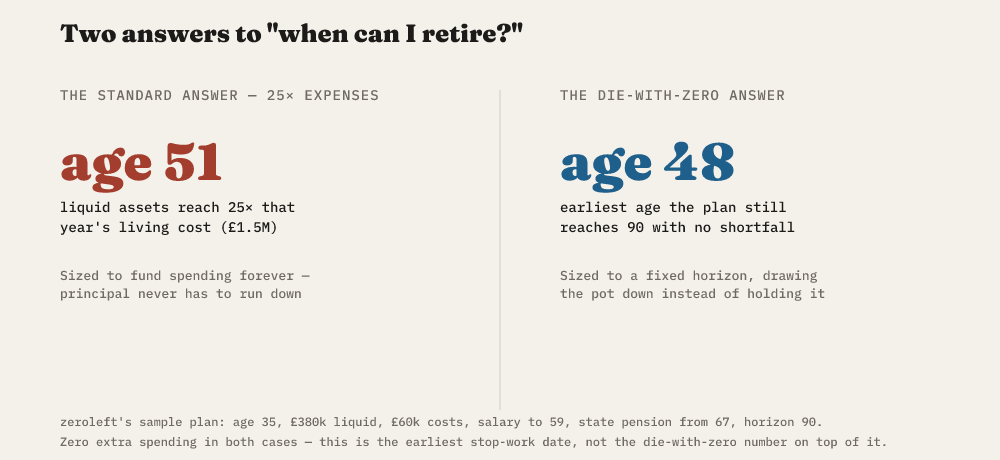
- The standard answer: age 51. That's the first age at which liquid assets (£1,556,816) clear 25 times that year's living cost (£1,500,000).
- The die-with-zero answer: age 48. That's the first age at which the plan — salary cut off there, nothing extra spent — still reaches 90 without a shortfall, using the state pension and continued investment growth to cover the gap.
Three years earlier, on the same numbers. Both figures here use zero extra spending — this isolates the retirement-date question from the separate question of how much more you could spend once retired, which is what the die-with-zero number covers. In fact, running the solver again at the later, standard-rule age of 51 shows the trade the other way round: this plan could still support about £9,569 a year of extra spending on top of costs, rather than banking three more years of full-time saving for a pot it will spend down anyway.
Where the earlier date needs care
- It's a flat projection, not a stress test. Sequence-of-returns risk — the risk that a bad run of markets lands in your first few years without earned income — can push a workable-looking date back out. A single projection like the one above can't show that; a Monte Carlo across thousands of market paths can, and zeroleft runs one.
- The 51-year figure above is arguably still generous. The 4% rule's own research was tested against roughly 30-year retirements. Retiring at 51 with a horizon to 90 is a 39-year retirement — longer than that window — and conventional advice would ask for a lower withdrawal rate, not the standard 4%, the longer the horizon runs. The two approaches aren't disagreeing by exactly three years of savings; they're solving for different things, and the standard figure has its own hidden margin either way.
- It assumes one fixed lifespan. Age 90 here is a planning horizon, not a probability. Living longer or shorter changes the answer in ways a single date can't show.
- It has no partner or household model. This is one person's assets, income and costs. A shared retirement date for two people needs both sets of numbers combined by hand — the engine doesn't do this for you.
- It has no tax model. Enter returns net of fees and tax; the date isn't adjusted for how withdrawals are actually taxed on the way out.
If an earlier date like this feels uncomfortable to trust, or you suspect you're the kind of saver who'd keep working past either number out of habit, the saving-too-much diagnostic is a gentler place to start. And if the whole comparison feels like a rerun of the FIRE debate, that's because it is — Die With Zero and FIRE disagree about exactly this margin more generally, not just at the point of retirement.
Run it on your own numbers
zeroleft runs this solve on your own assets, income and costs — not the sample plan — and then stress-tests whatever date it finds against thousands of market scenarios, so an earlier retirement date is something you can see the odds on, not just a single line on a chart.
It is a planning aid, not financial advice, and it has no tax model. Every assumption behind the numbers is on the methodology page.
Common questions
Can I retire earlier with Die With Zero than with the 4% rule?
Usually, yes, if you're comfortable spending down to roughly zero by a fixed horizon instead of keeping a pot that could last indefinitely. How much earlier depends entirely on your own numbers — the gap in zeroleft's own sample plan is a few years, not decades.
What is the die-with-zero survival threshold?
Bill Perkins' rule of thumb for the least you should keep back: 0.7 × your yearly cost of living × the years you have left. It's the floor a die-with-zero retirement date still has to clear.
Does a die-with-zero retirement date assume a fixed lifespan?
Yes — it's solved against one fixed planning horizon, not a probability of living longer or shorter. That's exactly why it needs a stress test across market and lifespan scenarios before you treat the date as a decision rather than a straight-line estimate.
zeroleft turns this into a plan you can act on — free, and the numbers run in your browser.
Start your plan →