The long-term care risk a spend-to-zero plan does not cover

Neither the book nor zeroleft's model gives long-term care its own line item — it's folded into ordinary living costs, which means a real, sometimes large late-life bill is quietly assumed away. You can build a manual buffer for it, but how you hold that buffer changes what it costs your plan today, and the difference is bigger than it looks.
The gap, named plainly
Die With Zero argues for spending down deliberately instead of hoarding against every possible future. That's a reasonable philosophy, but it leaves a real hole: a serious long-term care need late in life is exactly the kind of shock a spend-to-zero plan has the least room to absorb, and zeroleft's own criticism page already flags this honestly as something the model doesn't separate out. This page is the practical follow-up — how big the risk actually is, and what to do about it given how zeroleft's solver actually behaves.
How likely, and how much
The risk is real but concentrated. Research from the US Department of Health and Human Services finds that 70% of people who reach 65 go on to develop a severe long-term care need before they die, and 48% receive some amount of paid care over their lifetime — but most of that paid care is short. Among people who do receive it, 21% need it for more than two years, and only 3% need it for more than six (ASPE, ASPE research brief). Nursing-home stays specifically average 2.3 years among people who need them.
Cost is high per year. The 2024 CareScout Cost of Care survey puts the US national median annual cost of a semi-private nursing home room at $111,325, a private room at $127,750, and assisted living at $70,800 (CareScout). A widely cited 2016 PwC estimate put the average lifetime cost of long-term care across the whole population at around $172,000 (source, hosted by Genworth) — but that average is doing a lot of work. Most people need little or no paid care at all; a minority face bills that run into six figures within a couple of years. It's the kind of risk where the mean is a poor guide to any one household's outcome.
This matters for exactly the plan type zeroleft builds. A 2025 Morningstar retirement model found that households run short of money in retirement 41% of the time once long-term care costs are included in the simulation, against 26% of the time when they're excluded (Morningstar). That's research on retirement outcomes generally, not a finding about zeroleft's own model — but it's the clearest evidence that this specific unmodelled cost is large enough to matter, not a rounding error.
Two ways to hold a manual buffer, and what each actually costs
Since the engine doesn't model long-term care separately, the honest way to plan for it is to build the risk into your own plan by hand. There are two obvious ways to do that, and they are not equivalent.
The first is to add the cost as a future expense: a specific bill at a specific age, the way you'd enter any other cost. The second is to hold a reserve today — set an equivalent lump sum aside now, untouched, ring-fenced against the day you might need it.
Run both through zeroleft's actual solver, on the sample plan (a 35-year-old, $380,000 liquid, a $250,000 home, $60,000 of yearly costs, planning to 90), against a nursing-home bill sized to the CareScout median ($111,325 a year) for the 2.3-year average duration among nursing-home users, rounded to two years — $222,650 total:
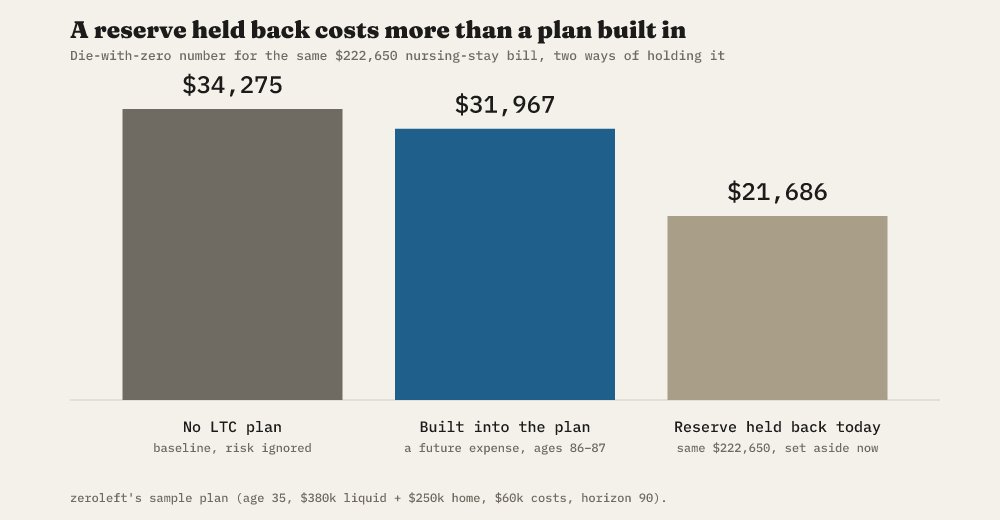
Building the bill into the plan as a future cost — money that keeps compounding for the decades until you actually need it — costs the sample plan $2,308 a year off its die-with- zero number. Setting the same $222,650 aside today and taking it out of the investable pool immediately costs $12,589 a year, more than five times as much, because that money gives up five decades of growth the moment it's set apart. If you're going to plan for a long-term care bill by hand, doing it as a dated future expense rather than an untouched reserve is the cheaper way to hold the same protection.
The survival threshold does not do this for you
It's tempting to assume you can cover this by leaning harder on zeroleft's survival threshold — the book's own backstop, a floor of 0.7 times your yearly cost of living times years remaining. It's worth being precise about what that number actually does: zeroleft's own criticism page already shows the solver's search doesn't treat it as a constraint, and testing it directly confirms the same thing here — raising the threshold factor well above its 0.7 default, on the same sample plan, changed the solved die-with-zero number by nothing at all. The figure is a sense check displayed alongside your results, not an input the solver reads. Inflating it doesn't build in a buffer for anything, long-term care included; only an actual change to your expenses or assets does that.
What this means for your plan
Most people who reach retirement will not face a six-figure long-term care bill, and it's reasonable not to plan your whole life around the tail case. But if you do want a cushion against it, model it the way the numbers above suggest: as a specific future expense at a plausible age, sized against a real cost figure like the CareScout median, rather than a lump sum quarantined from the rest of your plan today. zeroleft's planner lets you add exactly this kind of expense phase at whatever age and size you think is realistic, and re-solve your own die-with-zero number around it.
zeroleft is a planning aid, not financial advice, and has no dedicated long-term care model. It's an independent tool, not affiliated with or endorsed by Bill Perkins or the publisher.
Common questions
Does Die With Zero account for long-term care costs?
No, not as its own line item. Neither the book nor zeroleft's model separates a long-term care bill from ordinary living costs. If you want one covered, you have to add it to your plan yourself.
How much does long-term care cost?
In the US, the 2024 median cost of a semi-private nursing home room is $111,325 a year, a private room $127,750, and assisted living $70,800 (CareScout Cost of Care survey). Most people who ever need paid care need it for under two years; a minority need it for much longer.
What's the best way to plan for a long-term care bill in a die-with-zero plan?
Add it as a specific future expense at a plausible age, rather than setting an equivalent lump sum aside today and leaving it uninvested. Modelled on zeroleft's own solver, building the same bill in as a future cost preserves a meaningfully higher sustainable spend than reserving the money upfront, because the money keeps compounding until you actually need it.
zeroleft turns this into a plan you can act on — free, and the numbers run in your browser.
Start your plan →