Should you sell the house? Turning home equity into retirement spending

Selling a home in retirement turns illiquid equity into spendable cash, but usually a lot less of it than the sale price suggests. Before deciding whether to sell outright, borrow against the house, or take a reverse mortgage, it's worth knowing what each one actually leaves you to spend — not what the listing price or the equity on paper implies.
Three ways to turn a house into spending
- Sell outright. All of the remaining equity converts to cash, once selling costs and (if you buy again) purchase costs on the replacement are paid. You have to move.
- Borrow against it and stay: a home equity line of credit (HELOC). You keep the house and draw against its value as needed, usually at a variable rate, with required payments. Miss enough of them and the lender can foreclose, because the line is secured by the house.
- A reverse mortgage (in the US, usually a HECM — Home Equity Conversion Mortgage). Available from age 62. No monthly payment is required; the loan balance instead grows over time as unpaid interest and mortgage insurance compound. It's a non-recourse loan — you (or your estate) can never owe more than the home is worth when it's repaid, usually when you move out, sell, or die.
Selling is the only one of the three zeroleft can model directly today, because it maps onto an existing lever in the plan — more on that below. The other two are real, common choices; this guide covers their trade-offs honestly even where the tool can't yet run the exact numbers for you.
What selling actually nets, after the costs no one budgets for
The gap between the equity you think you're freeing and the cash you actually get to spend is the single most-underestimated part of downsizing. One 2026 analysis of typical downsizing moves found that transaction costs on both sides of the trade — agent commissions, transfer taxes, pre-listing repairs on the home being sold, then closing costs, inspections, and moving expenses on the replacement — routinely consume $90,000 or more, shrinking an expected $250,000 equity gap to roughly $155,000 actually freed: about 62% of what the numbers on paper suggested (Yahoo Finance). A second example in the same reporting: a couple expecting $375,000 in freed capital received $299,000 — a $76,000 gap that hit their first year of retirement cash flow because it hadn't been planned for. The same analysis also notes the move only pays off financially when it crosses a real cost-of-living boundary; staying in the same metro area at a similar price point produces close to nothing in net savings.
Run that erosion through zeroleft's own solver instead of a simple before-and-after comparison, and the effect is the same shape, just spread across the whole plan instead of landing as a single number:
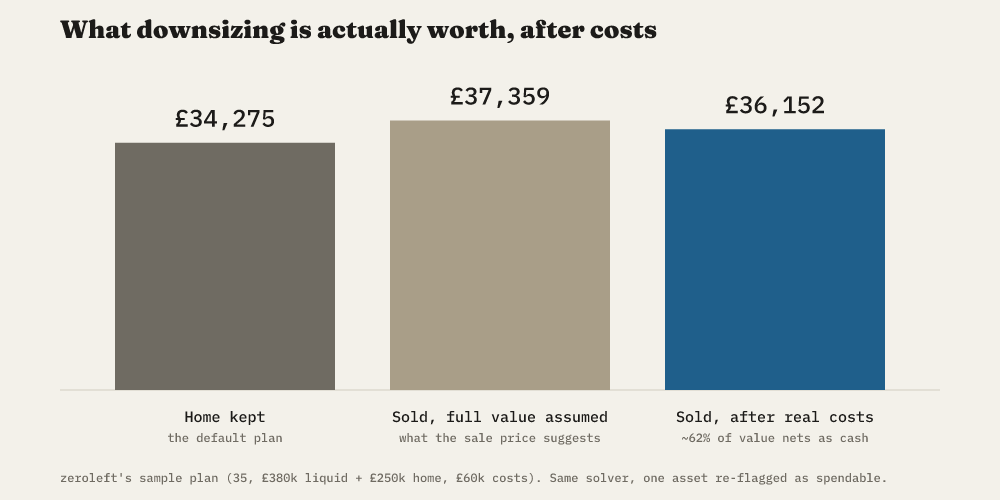
zeroleft's sample plan — a 35-year-old with about £380,000 in liquid assets, a £250,000 home, and £60,000 of yearly costs — solves to a baseline die-with-zero number of £34,275 a year with the home left untouched. Mark the home as spendable at its full value and the number rises to £37,359 — £3,084 a year more. Discount that same home value to the ~62% that typically nets as cash after real-world transaction costs, and the number is £36,152 instead: still an improvement over keeping the home, but only £1,877 a year, with roughly 39% of the assumed gain gone to costs before it ever reached the solver. The percentages are the point here, not the pound figures — your own home's value, and your own costs, will differ.
Staying put: HELOC vs. reverse mortgage
If moving isn't something you want, the other two routes let you keep the house and still draw on some of its value.
A HELOC is usually the cheaper option upfront and preserves more of your eventual equity, because you're borrowing, not selling, and typically pay it down over time like any other loan. The trade-off is that lenders qualify you on income, the rate is usually variable, and it demands ongoing payments — a real obligation on a fixed income, and one that puts the house at risk if you fall behind, since the line is secured by it (The Mortgage Reports).
A reverse mortgage (HECM) trades the opposite way: no monthly payment is required, and it's a non-recourse loan, so neither you nor your heirs can be left owing more than the home is worth. In exchange, it costs more to set up — an initial mortgage insurance premium of 2% of the home's value, an ongoing annual premium of 0.5% of the outstanding balance, and an origination fee (the greater of $2,500 or 2% of the first $200,000 of home value plus 1% of the amount above that, capped at $6,000) — and you must be 62 or older, with the home as your primary residence, and keep up with property taxes and insurance or risk default (2026 program figures via reverse.mortgage). Because nothing is paid down along the way, the balance compounds for as long as you stay, which steadily converts home equity into debt that's settled out of the sale proceeds when the loan ends — a slower, deferred version of the same trade selling outright makes all at once.
How this fits a die-with-zero plan
zeroleft's model treats a home as illiquid by default: it grows in value and counts toward net worth, but the solver never draws on it to fund spending — the same assumption the guide on planning without kids walks through for a different reason (there, no heir to keep it intact for; here, a decision to convert it to spending on purpose). Selling the home, in the model, is simply marking that one asset liquid at whatever you actually expect to net — which is exactly what the worked example above does, first at the full sale price, then discounted to a realistic recovery rate.
A HELOC or a reverse mortgage don't map onto that same flag as cleanly, because both create a genuine debt that grows or gets paid down on its own schedule rather than a one-time conversion of an asset from illiquid to liquid. zeroleft doesn't model either mechanic directly today — no variable-rate credit line, no compounding non-recourse balance with an age-62 gate. If you're weighing one of those two rather than an outright sale, the honest way to use the tool now is to estimate the cash you'd actually draw each year and add it as income, or model the eventual payoff as a liability — an approximation, not a simulation of the real product, and worth flagging as such if you build one.
The catches
- No tax model. Whether selling triggers capital gains, and how a reverse mortgage or HELOC draw is treated, depends on rules zeroleft doesn't apply. In the US, a single filer can typically exclude up to $250,000 of gain on a main home, and a married couple filing jointly up to $500,000, provided the home was owned and lived in for at least 2 of the last 5 years (IRS Topic 701) — many downsizers owe nothing, but a long-held home with a large gain, or a second home, can exceed that. Check your own numbers before assuming either way.
- The move itself has costs this guide's numbers already include, but your life doesn't reduce to them. Leaving a neighbourhood, downsizing possessions, and re-establishing routines and relationships elsewhere are real costs that don't show up in a solved number.
- A HELOC's payments and variable rate are a real obligation on a fixed income — this isn't free money, and the house secures it.
- A reverse mortgage's upfront costs and compounding balance mean it's the most expensive way to access the least amount of the equity fastest — it tends to suit someone who wants to stay put and needs no monthly payment specifically, not someone optimising for the largest number.
- This is a planning aid, not financial, legal, or tax advice, and none of the figures above are a quote for your own home, loan, or tax situation.
Run your own numbers
Whichever route you're actually considering, the number that matters is what it leaves you to spend, not the number on a listing or a lender's estimate. Build your plan in zeroleft, mark your own home liquid at the value you'd realistically expect to net, and see what it actually does to your die-with-zero number.
zeroleft is a planning aid, not financial, legal, or tax advice, and has no model for loan products or transaction costs beyond what you enter yourself. It's an independent tool, not affiliated with or endorsed by Bill Perkins or the publisher.
Common questions
How much equity does downsizing actually free up?
Usually a lot less than the sale price implies. Commissions, transfer taxes, repairs, moving costs, and the closing costs on a replacement home routinely eat 35-45% of the nominal equity gap between the old home and the new one. A couple expecting to free $250,000 by trading down often ends up with roughly $155,000 in hand.
Is a reverse mortgage or a HELOC better for retirement?
Neither is better in general; they suit different situations. A HELOC is usually cheaper and preserves more equity, but it requires income to qualify, charges a variable rate, and demands payments you can lose the house over if you fall behind. A reverse mortgage (HECM) needs no monthly payment and can't leave you owing more than the home is worth, but it costs more upfront, is only available from age 62, and its growing balance reduces what's left when you move out or die.
Do I pay capital gains tax when I sell my home in retirement?
Often not, if it's been your main home. In the US, single filers can exclude up to $250,000 of gain and married couples filing jointly up to $500,000, provided you owned and lived in the home for at least 2 of the last 5 years (IRS Topic 701). Gains above that, or a second home, are taxed as capital gains — check your own situation before assuming either way.
zeroleft turns this into a plan you can act on — free, and the numbers run in your browser.
Start your plan →