Do you need an annuity to die with zero?

Perkins doesn't say you need an annuity. He says you need a way to know your money won't run out before you do, and an annuity is the tool the Die With Zero method reaches for. Tested against zeroleft's own model, that advice holds up in part and needs care in part: a modest annuity barely changes your odds, and an oversized one bought from the same pot you'd otherwise rely on can make them worse, not better.
What the book actually argues
Die With Zero's answer to "what if I live longer than planned" is longevity insurance, not a bigger cushion. Perkins frames saving-for-a-long-life-just-in-case as the same over-saving trap the whole book argues against: you end up hoarding against a risk you could instead insure against directly. An annuity converts a lump sum into income for as long as you live, which turns an unknowable planning horizon into a known floor for at least part of your spending. Once that floor exists, the argument goes, you can spend the rest of the plan down without the fear driving you to under-spend everywhere.
That's the book's case, and it's specifically Perkins' argument — the book doesn't model how large an annuity should be, when to buy it, or what it does to a spend-down plan's numbers. That part needs a model, which is what the rest of this page tests.
What an annuity actually trades
An annuity swaps a lump sum for guaranteed income for life. The guarantee is real: it removes longevity risk entirely from the annuitised portion, for as long as the insurer stands behind it. What it trades away is flexibility — most annuities can't be unwound for their cash value once bought — and the payout is usually fixed in nominal terms, so it loses real value to inflation every year it isn't inflation-linked, and an inflation-linked version costs more upfront for a lower starting payment. zeroleft's own drawdown-strategies guide covers annuitising alongside the 4% rule, guardrails, and spend-to-zero as one of four ways to turn a portfolio into income; this page is about the annuity half specifically, in a die-with-zero plan.
Economists have a name for the gap between that theoretical case and what people actually do: the "annuity puzzle" — far fewer retirees buy annuities than models like the one above say they should. The commonly cited reasons are the ones above in practice, not just in theory: the illiquidity feels like a real loss even when the expected value works out, the payout is priced with the insurer's own margin built in, and comparing a fixed income stream against an invested, drawn-down alternative is a genuinely hard sum to do in your head. None of that makes the book's case wrong — it's research describing why people under-use a tool that can still be the right one for a specific situation, which is a different question from whether it's a good deal for you.
Tested against zeroleft's model
Take the question directly to the numbers. zeroleft's sample plan — a 35-year-old with about £380,000 in liquid assets, £60,000 of yearly costs, a horizon to 90 — solves to a die-with-zero number of £34,275 a year. Stress-tested across 500 randomised market paths, that flat number runs out early in 71% of them, because it's the exact edge of feasible, not a cushioned estimate.
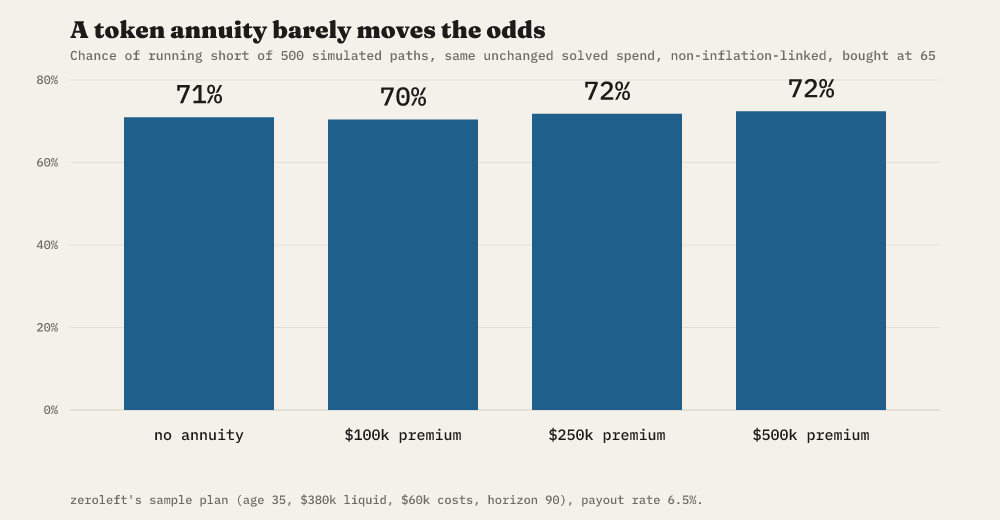
Add a £100,000 annuity at age 65, 6.5% payout, not inflation-linked, at the same unchanged spend, and the odds move from 71% to 70% — as zeroleft's criticism guide already found for this exact scenario. Scaling that same annuity up to £250,000 and £500,000, funded from the same pot, doesn't keep improving the number: it goes to 72% at both sizes — slightly worse than no annuity at all. The reason is the funding source, not the annuity itself: a premium that large has to come out of the same assets that would otherwise be a buffer in exactly the market paths where a bad early sequence hurts most. In a good number of the 500 simulated paths, the portfolio at 65 hasn't grown to comfortably cover a £500,000 premium on top of ordinary spending, so buying it removes cushion precisely where the plan needed it.
Structure matters more than size, in this test. Buying the same £100,000 premium inflation-linked instead of level moves the odds a little further, to 69% — a smaller change than the size comparison above, but in the right direction and without the downside: an inflation-linked payout doesn't erode over the decades before it's needed most, which is exactly the weakness in a level payout described above. zeroleft models an annuity as a lump-sum outflow at the purchase age and an income stream afterwards, optionally inflation-linked, so this is a direct read of the trade-off, not an estimate.
None of this is the last word on any specific annuity — real products vary in payout rate, inflation terms, and insurer pricing, and this is one sample plan, not yours. It does show that "buy a bigger annuity" isn't automatically the safer move once the premium comes from assets you might otherwise need as a buffer.
When an annuity is genuinely worth it
The test above funded every annuity from the same growth-oriented pot the solver draws down. That's the least favourable case for annuitising. Two changes to that setup are where the book's argument holds up better:
- Size it to the floor, not a round number. zeroleft's methodology already computes a survival-threshold figure — a backstop equal to 0.7 times your yearly cost of living times years remaining — as a reference for how much a bare-bones version of the rest of your life costs. An annuity sized to cover that floor specifically, rather than an arbitrary sum, is buying insurance against the actual risk, not a number that happens to be round.
- Defer it. A deferred annuity only has to fund the years past whichever age you choose to start it, so it costs less per pound of guaranteed income than one that starts paying immediately, because the insurer is pricing a shorter, later payout window. In the US, a Qualified Longevity Annuity Contract (QLAC) lets you buy this kind inside a tax-advantaged retirement account, with payments allowed to start as late as age 85 — you only need your other assets to carry you that far, not indefinitely.
Buying against the floor specifically, and starting it later, is a different proposition from the dose-response test above, which funded an arbitrary premium from an arbitrary account at 65. zeroleft's engine can model either shape — the numbers above show why it's worth testing your own before assuming either one helps.
The catches
zeroleft's annuity model is a simplification, deliberately. It doesn't quote you a real product, price counterparty risk, or account for the tax treatment of premiums and payouts — it has no tax model at all. It doesn't shop rates across insurers or apply state-guaranty-association protection limits. What it does is let you test the effect of an annuity whose terms you already have in mind against your own plan, stress-tested the same way the rest of the solve is. Treat the output as a comparison, not a quote.
Test your own numbers
zeroleft lets you add an annuity to your own plan — any premium, purchase age, and payout rate, inflation-linked or not — and see what it does to your solved number and your modelled chance of running short, side by side with the plan that skips it.
zeroleft is a planning aid, not financial advice, and has no tax model. It's an independent tool, not affiliated with or endorsed by Bill Perkins or the publisher.
Common questions
Does Die With Zero recommend annuities?
Yes, as one piece of the plan, not the whole of it. Perkins' argument is to buy longevity insurance for the years your money might not last, then spend the rest down without holding back a big cushion against that same fear. The book doesn't say how much to annuitise or when — that part needs a model.
Does an annuity guarantee you won't run out of money under a die-with-zero plan?
No. Tested against zeroleft's sample plan, a modest annuity funded from the same pot barely changed the modelled chance of running short, and a much larger one made it slightly worse, not better, because the premium came out of the same assets that would otherwise cushion a bad run of markets. Size and funding source both matter more than simply buying one.
What is a QLAC?
A Qualified Longevity Annuity Contract — a deferred annuity bought with money from a tax-advantaged retirement account, allowed under US rules to delay payments as late as 85. Because it only has to fund the years furthest out, it costs less per pound of guaranteed income than an annuity that starts paying immediately.
zeroleft turns this into a plan you can act on — free, and the numbers run in your browser.
Start your plan →